
What is E319?
tert-Butylhydroquinone (TBHQ, E319) — a synthetic antioxidant used in selected oils, fats and packaged foods.
tert-Butylhydroquinone (E319), usually called TBHQ, is a synthetic antioxidant used to help protect some fats and oils from oxidation. It is permitted in specified foods in Australia/NZ, the EU and the US. FDA 21 CFR 172.185 limits the total antioxidant content of the food’s oil or fat fraction. Goodnessly rates it Avoid as a preference against routine synthetic antioxidants.
Download our app to check additives in everyday foods
Read the FAQ →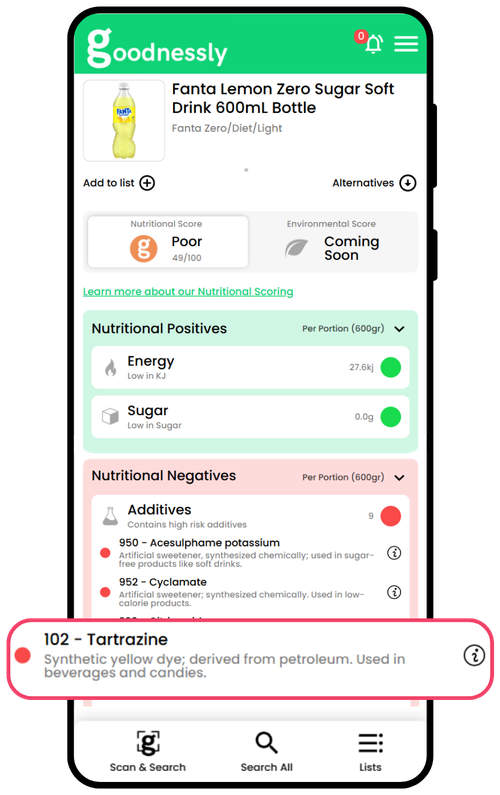
What is TBHQ?
TBHQ is a synthetic antioxidant used when a food maker wants to slow oxidation in a fat-containing formulation. Labels may say "tert-butylhydroquinone", "TBHQ", "319", "E319" or "antioxidant (319)".
What's it used for?
- Protecting selected edible oils and fats from oxidation
- Helping maintain flavour during shelf life
- Use alone or with other permitted antioxidants such as BHA or BHT
- Supporting stability in some packaged foods
Where you'll find E319 on the shelf
TBHQ is used in some packaged foods where protecting oils or fats during storage is part of the formulation.
Is TBHQ safe? What the research says
TBHQ has category-specific permissions and concentration conditions. FDA’s rule sets a limit based on the oil or fat content and the total antioxidant system. Goodnessly’s Avoid rating reflects a preference for fewer synthetic antioxidants, not a claim that permitted use is a ban or proven harm.
| Region | Status | What this means |
|---|---|---|
| AU/NZ Australia & New Zealand (FSANZ) | Permitted (specified foods; Schedule 15) | FSANZ lists tertiary butylhydroquinone as additive 319. The Food Standards Code sets category permissions and maximum levels, including limits for relevant fat and oil uses. |
| EU European Union (EFSA) | Authorised; category-specific conditions | E319 appears in the EU Union list under Regulation (EC) No 1333/2008 for specified food categories and conditions. Use limits depend on the food category and formulation. |
| US United States (FDA) | Permitted under 21 CFR 172.185 | 21 CFR 172.185 permits TBHQ as an antioxidant alone or with BHA and/or BHT. The rule limits total antioxidant content to 0.02 percent of the food’s oil or fat content, including essential oil content, and sets identity specifications. |
TBHQ is not the same substance as BHA (E320), BHT (E321) or propyl gallate (E310). The percentage in a finished food cannot be inferred from the ingredient list.
- FSANZ: additive 319 is listed with category-specific permissions and maximum levels.
- EU: E319 remains on the Union list for specified categories and conditions.
- FDA 21 CFR 172.185: sets identity, use and total-antioxidant conditions for TBHQ.
This section is checked periodically rather than continuously — if you're reading this well after the date above, it's worth confirming nothing has changed before citing it.
Who might want to limit or avoid it
- People who prefer to avoid synthetic antioxidants
- Households reducing packaged foods with multiple antioxidant codes
- Anyone comparing products and choosing the shorter ingredient list
Goodnessly rates E319 Avoid. TBHQ is permitted for specified uses in the three regions, but a household preference for fewer synthetic antioxidants keeps it out of Clear.
How to spot it on a label
Look for:
- tert-Butylhydroquinone
- TBHQ
- 319 or E319
- Antioxidant (319)
- TBHQ alongside BHA or BHT
Do not confuse E319 TBHQ with E320 BHA or E321 BHT; they are different antioxidant substances.
Related additives
Frequently asked questions
What is E319?
E319 is tert-butylhydroquinone, usually called TBHQ, a synthetic antioxidant used in selected foods.
Is TBHQ the same as BHA?
No. TBHQ is E319 and BHA is E320. They are different synthetic antioxidants, although a formulation may use more than one antioxidant.
Is TBHQ permitted in the US?
Yes. 21 CFR 172.185 permits TBHQ as an antioxidant under stated identity, use and total-antioxidant conditions.
Does Goodnessly rate E319 as safe, caution or avoid?
Goodnessly rates E319 (TBHQ) as Avoid.
Don't decode labels by hand
Scan any product with the Goodnessly app to instantly see its full additive breakdown, kept current as new research like this comes to light.
Download our app to check additives in everyday foods
At Goodnessly we aim to educate and empower individuals to make informed choices about everyday products.
© 2024 . All rights reserved.
Facebook
Instagram
X
TikTok