What is E392?
Rosemary extract (E392) is an antioxidant used in specified foods, with limits commonly expressed by its carnosol and carnosic-acid content. Goodnessly rates it Caution as a prompt to notice the source and use level.
E392 is an extract of rosemary used to help protect certain foods from oxidation. Its permitted composition and food-category limits matter.
Download our app to check additives in everyday foods
Read the FAQ →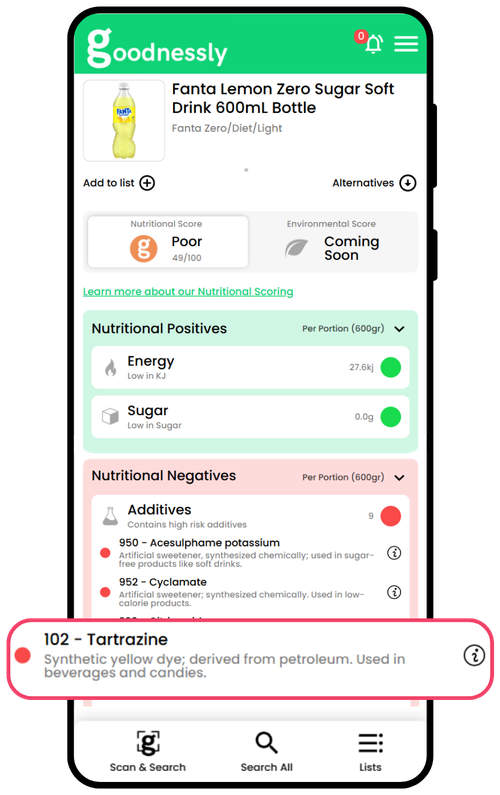
What is Rosemary extract?
Rosemary extract is made from rosemary and contains antioxidant compounds such as carnosol and carnosic acid. E392 is used for a technical antioxidant function in permitted foods.
What's it used for?
- Supporting oxidative stability in selected foods
- Protecting fats and oils during storage
- Supporting stability in specified meat and fish products
Where you'll find E392 on the shelf
It is most relevant to fats, oils, meat products, fish products and other foods where oxidative stability is important.
Is E392 permitted? What the regulators say
Rosemary extract is permitted in the three systems checked, but the permitted food category, extract specification and maximum level matter.
| Region | Status | What this means |
|---|---|---|
| AU/NZ Australia & New Zealand (FSANZ) | Permitted with conditions | FSANZ lists rosemary extract as additive 392; Schedule 15 conditions and maximum levels apply, often expressed using carnosic acid plus carnosol. |
| EU European Union (EFSA) | Authorised with conditions | The EU Union list includes E392 extracts of rosemary for specified categories and limits, expressed as the sum of carnosol and carnosic acid. |
| US United States (FDA) | GRAS natural extractive listing | FDA 21 CFR 182.20 lists rosemary among essential oils, solvent-free oleoresins and natural extractives GRAS for intended use; this does not automatically cover every concentrated extract or use. |
Goodnessly rates E392 Caution to encourage source and formulation awareness. This is not a claim that permitted rosemary extract use is harmful.
Eco score: Coming Soon.
- FSANZ A1254 approval material sets E392 category uses and levels.
- EUR-Lex Union-list provisions specify E392 categories and carnosol/carnosic-acid limits.
- FDA 21 CFR 182.20 lists rosemary natural extractives for intended use.
This section is checked periodically rather than continuously — if you're reading this well after the date above, it's worth confirming nothing has changed before citing it.
Who might want to limit or avoid it
- People with a known sensitivity to rosemary who need to check the label
- People comparing antioxidant systems in oils and processed foods
- People who prefer to understand the source of extracts
Goodnessly rates E392 Caution as a practical prompt to understand the ingredient, the product and the overall formulation.
How to spot it on a label
Look for:
- Rosemary extract
- 392 or E392
- Extracts of rosemary
- Antioxidant (392)
The label may show rosemary extract, E392 or the functional class antioxidant followed by the number.
Related additives
Frequently asked questions
What is E392?
E392 is rosemary extract, an antioxidant used in specified food applications.
Is E392 permitted?
E392 is permitted with conditions in Australia/New Zealand, the EU and the US. The extract, food category and use level still matter.
Why is rosemary extract rated Caution?
Goodnessly uses Caution as a label-reading prompt to notice the source, concentration and wider antioxidant system.
How does Goodnessly rate E392?
Goodnessly rates E392 (rosemary extract) as Caution.
Don't decode labels by hand
Scan any product with the Goodnessly app to instantly see its full additive breakdown, kept current as new research like this comes to light.
Download our app to check additives in everyday foods