What is E623?
Calcium glutamate — a flavour enhancer in the same family as MSG, giving food a savoury "umami" taste without adding sodium.
E623 (calcium glutamate) is the calcium version of monosodium glutamate (MSG), delivering the same umami flavour-enhancing effect without the extra sodium. EFSA's 2017 re-evaluation of the whole glutamate family found that realistic population exposure can exceed the group's safe daily intake, particularly for toddlers and children in high-consumption scenarios — though later analysis of market data indicates that estimate overstates real-world intake, and calcium glutamate specifically is far less commonly used than its sodium relative. Goodnessly rates it Caution.
Download our app to check additives in everyday foods
Read the FAQ →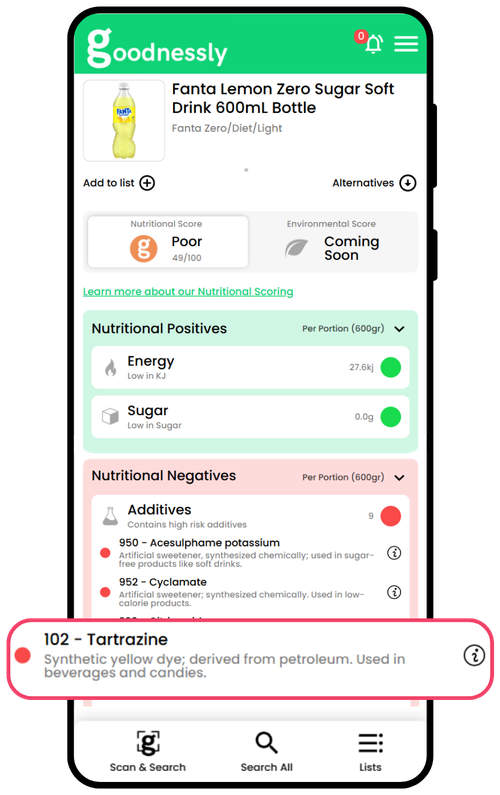
What is calcium glutamate?
Calcium glutamate is made by combining glutamic acid (a naturally occurring amino acid) with calcium, forming a flavour-enhancing compound in the same family as monosodium glutamate (MSG). It delivers the same distinctive savoury "umami" taste, discovered in 1908 and now recognised as one of the five basic tastes alongside sweet, sour, salty and bitter. Because it uses calcium rather than sodium, it's sometimes chosen by manufacturers looking to reduce a product's sodium content while keeping the same flavour profile.
What's it used for?
- Flavour enhancement in soups, sauces and seasonings
- Used in snack foods and savoury crackers
- Sodium-reduced alternatives to standard MSG-flavoured products
Where you'll find 623 on the shelf
Rare compared to standard MSG, mostly in sodium-reduced savoury products.
Is calcium glutamate safe? What the research says
Calcium glutamate is part of a family (E620–625) reviewed together by EFSA in 2017, and the real story here is about population-level exposure rather than the safety of any single dose.
| Region | Status | What this means |
|---|---|---|
| AU/NZ Australia & New Zealand (FSANZ) | Permitted | Permitted as a flavour enhancer, with maximum levels set by food category and a broader allowance in seasonings and condiments. |
| EU European Union (EFSA) | Permitted, ADI set | Listed as E623. EFSA's 2017 re-evaluation of the glutamate family (E620–625) set a group Acceptable Daily Intake of 30 mg per kilogram of bodyweight per day, expressed as glutamic acid, derived from a no-effect level of 3,200 mg/kg in a rat neurodevelopmental toxicity study. |
| US United States (FDA) | Not listed | No US clearance for calcium glutamate specifically. Glutamic acid (21 CFR 182.1045), MSG and monopotassium glutamate (21 CFR 182.1516) hold GRAS status, but the calcium salt isn't on the list. |
JECFA (the WHO/FAO expert committee) maintains an ADI of "not specified" for the glutamate family, reflecting a more reassuring international assessment than EFSA's group ADI. Glutamate is absorbed in the intestine and largely metabolised in the gut wall before reaching general circulation, and the family as a whole shows low acute toxicity.
- EFSA's 2017 exposure finding: under a realistic long-term exposure scenario, EFSA found that mean exposure to the glutamate family can exceed doses associated with reported effects like headache (sometimes called "MSG symptom complex") in toddlers and children, and that high-level exposure across all age groups can exceed the group ADI itself. Fine bakery goods were identified as a major contributing food category. That estimate assumed every food in each permitted category contained a glutamate; a later review of market data found under 1% of fine bakery wares actually do, so the modelled exposure is likely well above real intake.
- Calcium glutamate specifically is far less studied and far less used than sodium glutamate (MSG), so most of the individual symptom reports and research attention on this family concern MSG rather than the calcium salt covered here.
This section is checked periodically rather than continuously — if you're reading this well after the date above, it's worth confirming nothing has changed before citing it.
Who this matters to
- People who report headaches or other symptoms after consuming glutamate-heavy foods, sometimes called MSG sensitivity, though controlled trials have struggled to consistently confirm a causal link
- Parents of toddlers and young children, given EFSA specifically flagged this age group's exposure as worth further evaluation
- Anyone eating a diet heavy in processed foods containing multiple glutamate sources, where total exposure can add up
Goodnessly rates E623 Caution. It shares the same population-exposure concern EFSA identified for the whole glutamate family, but calcium glutamate specifically is far less commonly used than MSG itself, and JECFA's international assessment remains more reassuring than EFSA's.
How to spot it on a label
E623 must be declared clearly. Look out for:
- Calcium glutamate
- Calcium diglutamate
- 623 or E623
- "Flavour enhancer (623)" in the ingredients list
Soups, sauces and seasonings are the most common places to find it.
Related additives
Frequently asked questions
Is calcium glutamate the same as MSG?
Closely related but not identical — calcium glutamate is the calcium version of the same flavour-enhancing glutamate compound, while MSG (monosodium glutamate) uses sodium. Both deliver the same umami taste.
Does glutamate cause headaches or "MSG symptom complex"?
Some people report headaches and other symptoms after eating glutamate-heavy foods, often called MSG sensitivity or MSG symptom complex. EFSA's 2017 review noted that realistic exposure can exceed the doses associated with these reported effects in some population groups, particularly toddlers and children, though controlled trials have had difficulty consistently confirming a direct causal link in individuals.
Why is calcium glutamate rated differently from MSG on Goodnessly?
Both share the same underlying EFSA safety review and exposure concern, but calcium glutamate is used far less often than MSG, and most individual symptom reports and research attention on this additive family focus specifically on MSG rather than the calcium salt.
Does Goodnessly rate E623 as safe, caution, or avoid?
Goodnessly rates E623 (Calcium Glutamate) as Caution. It shares EFSA's population-exposure concern for the glutamate family, but is far less commonly used than MSG, and JECFA's international assessment remains more reassuring.
Don't decode labels by hand
Scan any product with the Goodnessly app to instantly see its full additive breakdown, kept current as new research like this comes to light.
Download our app to check additives in everyday foods