What is E621?
Monosodium glutamate (MSG) — the world's most widely used flavour enhancer, discovered over a century ago and still one of the most debated additives on any label.
E621 (monosodium glutamate, or MSG) is the sodium salt of glutamic acid, an amino acid your body already produces and that's naturally present in tomatoes, cheese and mushrooms. Decades of research have found no consistent evidence linking MSG to the headaches and other symptoms some people report (often called "MSG symptom complex"), but EFSA's 2017 review found that realistic high-level consumption can exceed the group's safe daily intake. Goodnessly rates it Avoid.
Download our app to check additives in everyday foods
Read the FAQ →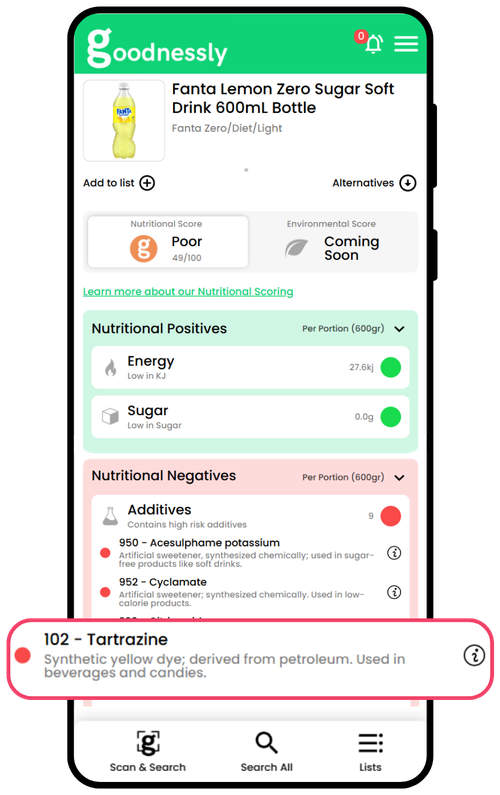
What is MSG?
MSG is the sodium salt of glutamic acid, one of the most common amino acids in nature, present in virtually every protein-containing food. In 1908, Japanese chemist Kikunae Ikeda isolated it from kelp broth and identified it as the source of "umami," the savoury taste now recognised as one of the five basic tastes. Commercial production began the following year and MSG has been in continuous use ever since, making it one of the longest-standing and most extensively studied food additives in existence. Modern MSG is produced by fermenting starch or sugar with bacteria, similar in principle to how yoghurt or vinegar is made.
What's it used for?
- Flavour enhancement in soups, sauces and instant noodles
- Savoury snack foods and seasonings
- Widely used in restaurant and takeaway cooking, particularly East and Southeast Asian cuisines
- Reducing sodium in low-salt products while maintaining savoury flavour
Where you'll find 621 on the shelf
Extremely common in savoury processed and restaurant-style foods.
Is MSG safe? What the research says
MSG is one of the most heavily researched food additives in history, and the science here is genuinely nuanced rather than one-sided.
| Region | Status | What this means |
|---|---|---|
| AU/NZ Australia & New Zealand (FSANZ) | Permitted | Must be declared as "monosodium glutamate" or "621" on the ingredient list. |
| EU European Union (EFSA) | Permitted, ADI set | Listed as E621, part of the same glutamate family (E620–625) covered on our Calcium Glutamate (E623) page. EFSA's 2017 group ADI is 30 mg per kilogram of bodyweight per day, expressed as glutamic acid. |
| US United States (FDA) | GRAS | Holds Generally Recognized As Safe status under 21 CFR 182.1. An independent review commissioned by the FDA (FASEB, 1995) concluded MSG is safe, while identifying short-term, mild symptoms in some sensitive people who consume 3 g or more without food. |
Reported oral LD50 values for MSG in rodents span roughly 10–20 grams per kilogram of bodyweight depending on species and form, indicating very low acute toxicity — for context, that would be around a kilogram for an average adult, far beyond any realistic dietary intake. Most of the glutamate people eat isn't an additive at all: total dietary glutamate in European countries runs about 5–12 grams a day, of which roughly 10 g is bound up in protein, about 1 g is free glutamate occurring naturally in food, and only around 0.4 g comes from added MSG.
- Decades of research on "MSG symptom complex": the term "Chinese Restaurant Syndrome" was first coined in 1968. Since then, systematic reviews spanning over 40 years of research have consistently found no strong, reliable evidence linking typical MSG consumption to headaches or the other reported symptoms in controlled studies, though some sensitive individuals in controlled trials reported mild, short-term symptoms when given large doses without food — the FDA puts that threshold at 3 g or more, against a typical serving of an MSG-containing food that holds under 0.5 g.
- EFSA's 2017 exposure finding applies here too: the same population-level exposure concern covered on our Calcium Glutamate page applies more directly to MSG, since it's far more widely consumed than the calcium salt — this is the main reason Goodnessly rates MSG more cautiously than calcium glutamate.
- Combination effects noted in lab research: one 2006 study found that combining the synthetic dye Brilliant Blue FCF (E133) with L-glutamic acid — the parent acid of MSG — slowed the growth of nerve-cell projections in cultured mouse cells by more than the two would be expected to on their own, suggesting the combined effects of multiple additives aren't always simply additive. This is a single laboratory finding in cell culture and hasn't been established as a real-world dietary risk.
This section is checked periodically rather than continuously — if you're reading this well after the date above, it's worth confirming nothing has changed before citing it.
Who might want to limit or avoid it
- People who've noticed headaches or other symptoms after eating glutamate-heavy foods, even though controlled trials haven't consistently confirmed a causal link for most people
- Parents of toddlers and young children, given EFSA specifically flagged this age group's exposure as worth further evaluation
- Anyone eating a diet heavy in processed, restaurant or takeaway food, where total glutamate exposure from multiple sources can add up
- Anyone who prefers to limit non-essential flavour-enhancing additives on principle
Goodnessly rates E621 Avoid. It remains one of the most extensively studied additives in the world, with GRAS status and decades of research finding no consistent evidence of harm at typical intake — but EFSA's 2017 exposure finding, combined with how widely MSG is consumed, places it in our highest-caution category.
How to spot it on a label
E621 must be declared clearly, but related glutamate sources are less obvious. Look out for:
- Monosodium glutamate
- 621 or E621
- Hydrolysed vegetable protein, yeast extract or autolysed yeast (naturally contain free glutamate)
- "Natural flavouring," stock or bouillon (sometimes contain glutamate sources)
Instant noodles, soups and savoury snacks are the most common places to find it.
Related additives
Frequently asked questions
Does MSG really cause headaches or "Chinese Restaurant Syndrome"?
The term was first coined in 1968, but over 40 years of systematic research have found no strong, consistent evidence linking typical MSG consumption to headaches in controlled studies. Some sensitive individuals reported mild, short-term symptoms in trials, but generally only at large doses taken without food — the FDA puts that threshold at 3 g or more, while a typical serving of an MSG-containing food holds under 0.5 g.
Is glutamate natural or artificial?
Glutamic acid is a completely natural amino acid, present in your own body and in virtually every protein-containing food, including tomatoes, cheese and mushrooms. MSG itself is produced by fermenting starch or sugar with bacteria, similar in principle to how vinegar or yoghurt is made.
How can I tell if a product contains glutamate without added MSG?
Ingredients like hydrolysed vegetable protein, yeast extract, autolysed yeast, soy protein isolate and some "natural flavourings" can release free glutamate during processing, even though the product doesn't list "MSG" or "621" directly.
Does Goodnessly rate E621 as safe, caution, or avoid?
Goodnessly rates E621 (MSG) as Avoid. It has GRAS status and decades of research finding no consistent evidence of harm at typical intake, but EFSA's 2017 finding that realistic high-level consumption can exceed the safe daily intake, combined with how widely MSG is consumed, places it in our highest-caution category.
Don't decode labels by hand
Scan any product with the Goodnessly app to instantly see its full additive breakdown, kept current as new research like this comes to light.
Download our app to check additives in everyday foods