
What is E625?
Magnesium diglutamate — a magnesium salt in the E620–E625 glutamate flavour-enhancer group assessed with MSG.
Magnesium glutamate (E625), also called magnesium diglutamate, is a flavour enhancer in the glutamic acid–glutamates group (E620–E625). It is used for the same savoury / umami purpose as MSG, with magnesium as the counter-ion instead of sodium. It is permitted in Australia/NZ and the EU within that group. EFSA's 2017 group ADI is 30 mg/kg body weight per day expressed as glutamic acid, with possible exceedance for some high consumers. It is less common on supermarket labels than monosodium glutamate (E621), but shares the same group assessment. Goodnessly rates it Avoid.
Download our app to check additives in everyday foods
Read the FAQ →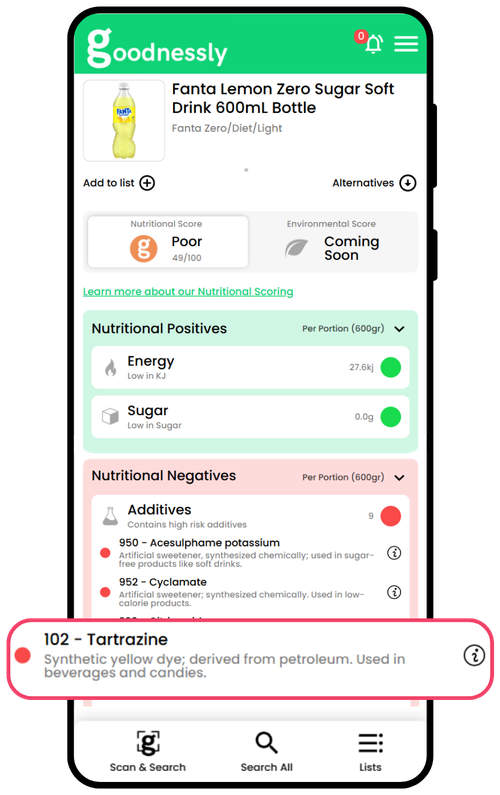
What is magnesium glutamate?
Magnesium glutamate (E625) is the magnesium salt of L-glutamic acid used as a flavour enhancer. EFSA assesses it with glutamic acid and the other glutamate salts under one group ADI. On labels you may see "magnesium glutamate", "magnesium diglutamate", "625", "E625", or "flavour enhancer (625)".
What's it used for?
- Savoury / umami flavour enhancing in seasonings and stocks
- Used in soups, sauces and ready meals where glutamates are permitted
- Lower-sodium glutamate option versus MSG in some formulations
- Part of the E620–E625 flavour-enhancer family
Where you'll find E625 on the shelf
Uncommon compared with MSG, but possible in the same savoury processed-food aisle whenever a non-sodium glutamate salt is chosen.
Is magnesium glutamate safe? What the research says
There is no separate EFSA ADI for E625 alone — it sits inside the 2017 glutamates group opinion. Exposure concerns for high consumers of additive glutamates therefore apply to the group, not only to MSG. Goodnessly's Avoid rating matches E620 and E621 rather than treating the magnesium salt as a loophole.
| Region | Status | What this means |
|---|---|---|
| AU/NZ Australia & New Zealand (FSANZ) | Permitted (glutamates group, GMP) | Listed as magnesium glutamate (625) with other glutamates in the Food Standards Code as a flavour enhancer for permitted categories (generally GMP). Must be declared by name or number when used as a food additive. |
| EU European Union (EFSA) | Authorised; group ADI 30 mg/kg bw/day | Authorised as E625 under Regulation (EC) No 1333/2008. Covered by EFSA's 2017 re-evaluation of E620–E625 (group ADI 30 mg/kg bw/day as glutamic acid) and the same high-consumer exposure discussion. |
| US United States (FDA) | Glutamate family (see MSG / glutamic acid GRAS) | Magnesium diglutamate is not as prominently listed as a standalone Part 182 section as MSG or glutamic acid; US products more often declare monosodium glutamate. FDA continues to treat common glutamate flavour-enhancer uses as GRAS when used under GMP. This page does not invent a unique CFR section number for E625. |
Choosing magnesium glutamate instead of MSG changes the mineral counter-ion; it does not remove the product from the glutamate flavour-enhancer family or from EFSA's group ADI. Sensitivity associations discussed for high-glutamate meals are about susceptible individuals, not a general-population diagnosis.
- EFSA 2017 (E620–E625): E625 included in the group ADI of 30 mg/kg bw/day as glutamic acid; high-consumer exceedance notes apply to the group.
- Label reality: E621 remains far more common on packs than E625 — still check for any 620–625 code.
- FSANZ: magnesium glutamate remains a listed flavour enhancer alongside other glutamates.
This section is checked periodically rather than continuously — if you're reading this well after the date above, it's worth confirming nothing has changed before citing it.
Who might want to limit or avoid it
- People avoiding added glutamates / MSG-family flavour enhancers
- Anyone reducing ultra-processed savoury seasonings and ready meals
- Shoppers who already avoid E621 and want the same rule for other glutamate salts
Goodnessly rates E625 Avoid. Magnesium glutamate remains permitted with the wider glutamates group, but EFSA's group ADI exposure concerns and our MSG-family stance leave no Clear path for this salt alone.
How to spot it on a label
Check savoury processed foods for:
- Magnesium glutamate / magnesium diglutamate
- 625 or E625
- Flavour enhancer (625)
- Other glutamates: 620–624
Less common than MSG (621) — same Avoid family if present.
Related additives
Frequently asked questions
What is Magnesium glutamate (E625) made from?
It is the magnesium salt of L-glutamic acid, manufactured for use as a savoury flavour enhancer. It belongs to the same additive group as MSG (E621).
Is magnesium glutamate healthier than MSG?
It swaps sodium for magnesium as the counter-ion. Regulators still assess it inside the same glutamates group ADI. Goodnessly rates both Avoid — it is not treated as a free pass.
Is E625 common in Australian products?
It is permitted, but monosodium glutamate (621) is the glutamate salt you will see most often. Always read the full flavour-enhancer line.
Does Goodnessly rate E625 as safe, caution or avoid?
Goodnessly rates E625 (Magnesium glutamate) as Avoid.
Don't decode labels by hand
Scan any product with the Goodnessly app to instantly see its full additive breakdown, kept current as new research like this comes to light.
Download our app to check additives in everyday foods
At Goodnessly we aim to educate and empower individuals to make informed choices about everyday products.
© 2024 . All rights reserved.
Facebook
Instagram
X
TikTok