What is 631?
A savoury flavour enhancer, usually paired with MSG and disodium guanylate to boost umami taste.
Disodium 5'-inosinate (631) is the sodium salt of inosinic acid, a nucleotide found naturally in meat and fish. It is used as a flavour enhancer, usually together with MSG (621) and disodium guanylate (627). It is permitted in Australia, New Zealand, the EU and the US. JECFA has allocated it an Acceptable Daily Intake "not specified". Goodnessly rates it Limited Risk.
Download our app to check additives in everyday foods
Read the FAQ →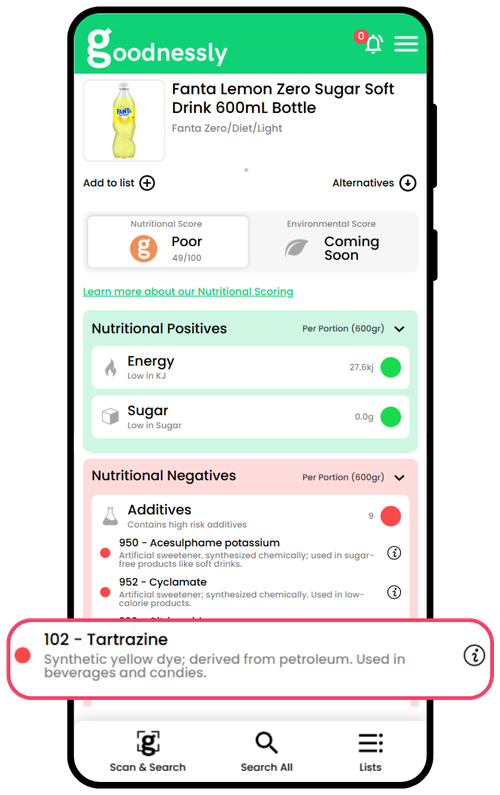
What is disodium 5'-inosinate?
Inosinate is a nucleotide that contributes to the savoury taste of meat and fish. Commercially it is made by fermentation or extracted from animal sources. It boosts the taste of glutamate, so small amounts go a long way.
What's it used for?
- Flavour enhancer in chips and flavoured snacks
- Instant noodles, soups and stock
- Seasonings and sauces
- Processed meats and ready meals
Where you'll find 631 on the shelf
It is most common in savoury snacks and instant meals.
Is disodium 5'-inosinate safe? What the research says
Regulators consider disodium inosinate acceptable at permitted levels. Because it is purine-derived, people advised to limit purines (for example people with gout) sometimes choose to avoid it.
| Region | Status | What this means |
|---|---|---|
| AU/NZ Australia & New Zealand (FSANZ) | Permitted | Listed as a flavour enhancer in the Food Standards Code. Declared as "flavour enhancer (631)" or by name. |
| EU European Union (EFSA) | Permitted | Authorised as E631 under Regulation (EC) No 1333/2008. |
| US United States (FDA) | Permitted | Permitted as a flavour enhancer under 21 CFR 172.535. |
JECFA's evaluation of the 5'-ribonucleotides concluded that a numerical Acceptable Daily Intake was not needed.
- JECFA position: The Acceptable Daily Intake "not specified" for 5'-ribonucleotides remains in place.
- EU re-evaluation programme: E631 is part of the EU re-evaluation of food additives authorised before 2009.
- Labelling in AU/NZ: FSANZ requires flavour enhancers to be declared by class name plus name or number.
This section is checked periodically rather than continuously — if you're reading this well after the date above, it's worth confirming nothing has changed before citing it.
Who might want to limit or avoid it
- People advised to limit purines, such as people with gout (check with your doctor)
- Vegans and vegetarians, since it may come from animal sources
- People who prefer to limit flavour enhancers in processed foods
Goodnessly rates 631 Limited Risk. It is permitted everywhere with no numerical intake limit, but its use in processed savoury foods puts it in our Limited Risk category.
How to spot it on a label
Look out for:
- Disodium 5'-inosinate
- Disodium inosinate
- 631 or E631
- Flavour enhancer (631)
When combined with 627 it may be listed as 635 instead.
Related additives
Frequently asked questions
Is disodium inosinate MSG?
No. MSG (621) is a glutamate, while disodium inosinate is a nucleotide. They are often used together because the combination tastes much more savoury than either alone.
Is disodium inosinate vegan?
It may be made by fermentation or from meat or fish. Labels usually do not say which, so check with the manufacturer if this matters to you.
Is disodium inosinate safe?
It is permitted by FSANZ, the EU and the FDA, and JECFA did not consider a numerical intake limit necessary.
How does Goodnessly rate 631?
Goodnessly rates 631 (disodium 5'-inosinate) as Limited Risk. It is permitted everywhere with no numerical intake limit, but its use in processed savoury foods puts it in this category.
Don't decode labels by hand
Scan any product with the Goodnessly app to instantly see its full additive breakdown, kept current as new research like this comes to light.
Download our app to check additives in everyday foods