What is E969?
Advantame — one of the newest and most intensely sweet artificial sweeteners approved, roughly 20,000 times sweeter than sugar, used in vanishingly small amounts.
E969 (advantame) is a synthetic sweetener made from aspartame and vanillin, so intensely sweet that only tiny amounts are ever used. It's approved in Australia, the US and the EU, but it's one of the newest sweeteners on the market, and consumer-advocacy group CSPI has flagged genuine methodology concerns in the animal studies behind its approval. Goodnessly rates it Avoid.
Download our app to check additives in everyday foods
Read the FAQ →
What is advantame?
Advantame is a synthetic sweetener made by chemically combining aspartame with vanillin (the compound behind artificial vanilla flavour). The result is extraordinarily sweet — roughly 20,000 times sweeter than sugar and around 100 times sweeter than aspartame itself — so only minuscule amounts are ever needed. Unlike aspartame, advantame doesn't require a phenylketonuria (PKU) warning label, since it releases only negligible amounts of phenylalanine when broken down in the body. It's also more heat-stable than aspartame, holding its sweetness at temperatures up to around 240°C.
What's it used for?
- Sweetening diet soft drinks and flavoured drinks
- Sugar-free chewing gum
- Low-calorie dairy products and ice cream
- Baked goods, jams and confectionery
- Masking bitter notes in other products, alongside its sweetening role
Where you'll find 969 on the shelf
Still uncommon in Australia, but present in a growing range of sugar-free products.
Is advantame safe? What the research says
Advantame's approval rests on 37 animal and human studies, but consumer-advocacy scrutiny of two of the key studies, plus its newness and a broader 2023 WHO position on sweeteners, are worth knowing about.
| Region | Status | What this means |
|---|---|---|
| AU/NZ Australia & New Zealand (FSANZ) | Permitted | Permitted as a sweetener and flavour enhancer, though still uncommon in Australian products. |
| EU European Union (EFSA) | Permitted, ADI set | Listed as E969, approved since 2013/2014. EFSA set an Acceptable Daily Intake of 5mg per kilogram of bodyweight per day. |
| US United States (FDA) | Approved | Approved in 2014 as a general-purpose sweetener and flavour enhancer (excluding meat and poultry), based on a review of 37 animal and human studies. |
Advantame is metabolised similarly to aspartame, breaking down into aspartic acid, phenylalanine and vanillin-related compounds, but it releases such a small amount of phenylalanine that it doesn't require a PKU warning label. High-dose animal studies used to establish the daily intake limit found intestinal effects at very high doses, well above realistic human exposure given how little advantame is needed per serving.
- Study methodology concerns at approval (2014): the consumer-advocacy group CSPI reviewed the animal studies submitted for FDA approval and raised concerns about two of them. In the mouse cancer study, the number of animals that survived to the end of the study fell below the FDA's own recommended standard, and an FDA statistician noted this low survival rate "probably masked the occurrence of late developing tumors." In the rat cancer study, some FDA scientists reportedly raised objections of their own about aspects that "may have compromised and confounded the outcome of the results." CSPI itself noted that because advantame is used in such tiny amounts, any resulting cancer risk would likely be negligible — but flagged the study design issues as a legitimate concern regardless.
- WHO's 2023 non-sugar sweetener guideline: the World Health Organization recommended against using non-sugar sweeteners for weight control, based on a systematic review covering eight sweeteners including advantame, citing potential associations with increased type 2 diabetes and cardiovascular disease risk with long-term use. This was a general recommendation about the sweetener category, not a finding specific to advantame's own safety.
This section is checked periodically rather than continuously — if you're reading this well after the date above, it's worth confirming nothing has changed before citing it.
Who might want to limit or avoid it
- People with phenylketonuria (PKU), who should still be cautious with any aspartame-derived sweetener even though advantame's phenylalanine release is negligible
- Anyone using non-sugar sweeteners specifically for weight management, given the WHO's 2023 guidance questioning their long-term benefit for that purpose
- Anyone who prefers to wait for more real-world, long-term data given how recently advantame was approved compared to older sweeteners
- Anyone who weighs regulatory-approval process concerns seriously, given CSPI's documented objections to two of the pre-approval animal studies
Goodnessly rates E969 Avoid. It remains legally approved based on 37 reviewed studies, but the combination of documented study-design concerns at approval, its relative newness, and its place within the WHO's broader caution around non-sugar sweeteners places it in our highest-caution category.
How to spot it on a label
Advantame must be declared clearly. Look out for:
- Advantame
- 969 or E969
- "Sweetener (969)" in the ingredients list
- Often listed alongside other sweeteners like sucralose or aspartame
Diet soft drinks and sugar-free chewing gum are the most likely places to find it.
Related additives
Frequently asked questions
Is advantame related to aspartame?
Yes — advantame is made by chemically combining aspartame with vanillin. It's roughly 100 times sweeter than aspartame itself, and unlike aspartame, it doesn't require a PKU warning label since it releases only negligible phenylalanine when metabolised.
Why is advantame used in such tiny amounts?
Because it's extraordinarily sweet — around 20,000 times sweeter than sugar. A tiny fraction of the amount needed for regular sugar delivers the same sweetness, which is also why any potential health risk from the additive itself is generally considered very low: the actual exposure per serving is minuscule.
Did mice die in advantame safety studies?
Not in the sense of the additive causing deaths. The consumer-advocacy group CSPI raised a different concern: in the mouse cancer study submitted for FDA approval, fewer mice survived to the end of the study than FDA's own standards recommend, which an FDA statistician said may have masked whether late-developing tumours would have appeared. This is a study-design concern about statistical reliability, not evidence that advantame directly harmed the animals.
Does Goodnessly rate E969 as safe, caution, or avoid?
Goodnessly rates E969 (Advantame) as Avoid. It remains legally approved based on 37 reviewed studies, but the combination of documented study-design concerns raised at approval, its relative newness, and its inclusion in the WHO's 2023 caution around non-sugar sweeteners places it in our highest-caution category.
Is advantame safe for people with PKU?
Advantame releases only negligible phenylalanine when broken down in the body, which is why it doesn't require a PKU warning label, unlike aspartame. People with phenylketonuria may still want to exercise some caution with any aspartame-derived sweetener, and can consult their doctor if unsure.
Don't decode labels by hand
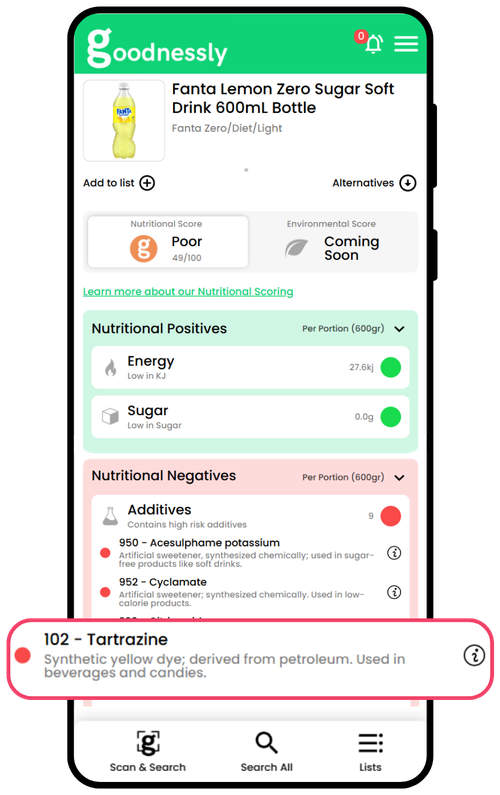
Scan any product with the Goodnessly app to instantly see its full additive breakdown, kept current as new research like this comes to light.
Download our app to check additives in everyday foods