
What is E951?
Aspartame — one of the world's most-studied sweeteners, still legally approved everywhere, but the subject of a 2023 IARC classification that keeps the conversation about it alive.
E951 (aspartame) is a low-calorie artificial sweetener made from two amino acids, roughly 200 times sweeter than sugar. It's approved in Australia, the EU and the US, with regulators maintaining an Acceptable Daily Intake that a typical adult would need to drink many cans of diet soft drink every single day, consistently, to approach. In July 2023, the World Health Organization's cancer research arm (IARC) classified it as "possibly carcinogenic to humans," a hazard classification based on limited evidence, while the WHO's own food safety body (JECFA) reviewed the same evidence on the same day and kept its intake limit unchanged. People with the genetic condition phenylketonuria (PKU) must avoid it because it breaks down into phenylalanine. Goodnessly rates it Avoid.
Download our app to check additives in everyday foods
Read the FAQ →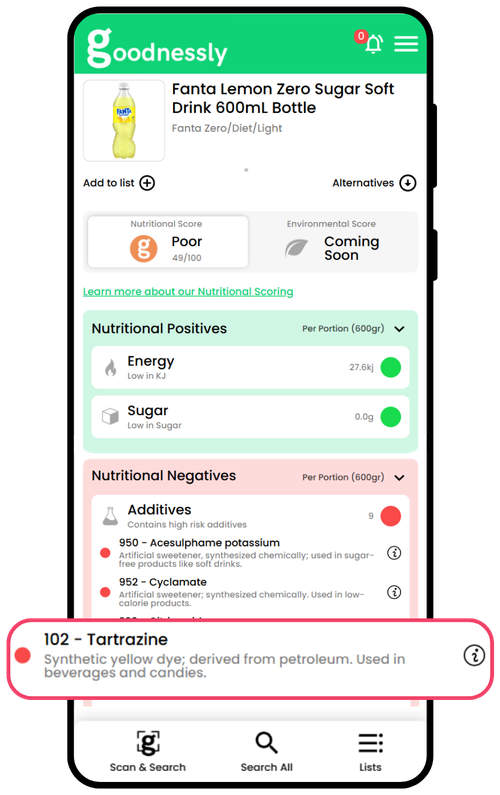
What is aspartame?
Aspartame is a low-calorie artificial sweetener made by joining two amino acids, aspartic acid and phenylalanine, together with a methyl group. It's around 200 times sweeter than table sugar, so only tiny amounts are needed to sweeten food and drinks. Once eaten, it's broken down in the digestive system into aspartic acid, phenylalanine and a small amount of methanol — all of which also occur naturally in many other everyday foods, though aspartame is one of the most extensively studied food additives ever approved, with decades of research behind its current safety limits.
What's it used for?
- Sweetening diet and zero-sugar soft drinks
- Sugar-free chewing gum and confectionery
- Tabletop sweetener sachets and tablets
- Some flavoured yoghurts, desserts and protein products
Where you'll find E951 on the shelf
It shows up wherever a product is marketed as diet, zero-sugar, low-calorie or sugar-free.
Is aspartame safe? What the research says
Aspartame has one of the longest and most heavily scrutinised safety records of any food additive, and its 2023 review is a good example of how a hazard classification and a risk assessment can reach different-sounding conclusions from the same evidence.
| Region | Status | What this means |
|---|---|---|
| AU/NZ Australia & New Zealand (FSANZ) | Permitted | Permitted with an Acceptable Daily Intake of 40 milligrams per kilogram of body weight per day, matching JECFA. Products must carry a "contains phenylalanine" warning. |
| EU European Union (EFSA) | Permitted, ADI reaffirmed | EFSA's comprehensive 2013 re-evaluation reaffirmed the Acceptable Daily Intake of 40 milligrams per kilogram of body weight per day, finding population exposure estimates stayed within that limit. Products must carry the same PKU warning. |
| US United States (FDA) | Approved | Approved since 1981 following a lengthy and at times contentious review process, with an Acceptable Daily Intake of 50 milligrams per kilogram of body weight per day — slightly higher than the JECFA/EU figure. Also requires a PKU warning. |
To put the Acceptable Daily Intake in perspective, a 70-kilogram adult using JECFA's limit of 40 milligrams per kilogram per day would need to drink well over a dozen cans of diet soft drink, every single day, consistently, before approaching it — a level of intake regulators note is far beyond typical everyday consumption for almost everyone.
- IARC's 2023 Group 2B classification: in July 2023, the International Agency for Research on Cancer classified aspartame as "possibly carcinogenic to humans" (Group 2B), based on limited evidence primarily from some observational studies looking at liver cancer. Group 2B is a hazard classification, meaning some evidence exists that a substance could theoretically cause cancer under some circumstance; it says nothing on its own about how likely that is at real-world exposure levels. Other Group 2B substances include aloe vera extract and pickled vegetables.
- JECFA's ADI maintained on the same day: the WHO's own food additive risk-assessment body, JECFA, reviewed the same body of evidence alongside IARC and concluded there was insufficient reason to change its risk assessment, maintaining the Acceptable Daily Intake at 40 milligrams per kilogram of body weight per day.
- Two different questions, two different bodies: IARC asks "could this substance be a cancer hazard under any circumstance?" while JECFA asks "how much of this substance can a person safely consume in real life?" Both reviewed aspartame in 2023 and neither called for a ban or a change to how it's used in food.
This section is checked periodically rather than continuously — if you're reading this well after the date above, it's worth confirming nothing has changed before citing it.
Who might want to limit or avoid it
- People with phenylketonuria (PKU), who must avoid aspartame entirely because it releases phenylalanine on digestion, which their bodies can't process normally
- Anyone who prefers to wait and see how the scientific conversation around IARC's 2023 classification develops further, even though JECFA's own risk assessment found no reason to change the intake limit
- People who consume large volumes of diet soft drinks or sugar-free products daily and want to keep an eye on total intake across multiple products, simply as a matter of variety
Goodnessly rates E951 Avoid. It remains legally approved everywhere with a long safety record and an unchanged JECFA intake limit, but IARC's 2023 hazard classification is enough of an open question for us to flag it rather than clear it outright.
How to spot it on a label
E951 must be declared clearly, and products containing it carry an additional warning. Look out for:
- Aspartame
- 951 or E951
- "Contains a source of phenylalanine" (mandatory PKU warning)
It's almost always found in products explicitly marketed as diet, zero, low-calorie or sugar-free.
Related additives
Frequently asked questions
Does aspartame cause cancer?
In July 2023, IARC classified aspartame as possibly carcinogenic to humans (Group 2B), based on limited evidence. This is a hazard classification, meaning some evidence exists it could theoretically be a cancer risk under some circumstance, not a statement about how likely that is in real life. On the same day, JECFA reviewed the same evidence and kept aspartame's Acceptable Daily Intake unchanged, finding no reason to change its risk assessment at normal consumption levels.
Why is aspartame's ADI different in the US than other countries?
The US FDA set an Acceptable Daily Intake of 50 milligrams per kilogram of body weight per day, while JECFA, the EU and Australia/New Zealand use 40 milligrams per kilogram per day. Both figures were derived from safety testing with built-in safety margins, and both sit well above typical everyday consumption levels.
Who needs to avoid aspartame completely?
People with phenylketonuria (PKU) must avoid aspartame entirely, because it breaks down into phenylalanine, an amino acid their bodies can't process normally. This is why products containing aspartame carry a mandatory warning for people with PKU.
Does Goodnessly rate E951 as safe, caution or avoid?
Goodnessly rates E951 (Aspartame) as Avoid. It remains legally approved everywhere with a long safety record and an unchanged JECFA intake limit, but IARC's 2023 possibly-carcinogenic classification is enough of an open question for us to flag it rather than clear it outright.
Don't decode labels by hand
Scan any product with the Goodnessly app to instantly see its full additive breakdown, kept current as new research like this comes to light.
Download our app to check additives in everyday foods
At Goodnessly we aim to educate and empower individuals to make informed choices about everyday products.
© 2024 . All rights reserved.
Facebook
Instagram
X
TikTok