
What is maltodextrin?
Also labelled: Maltodextrin · Maltodextrins · Corn maltodextrin · Tapioca maltodextrin · Wheat maltodextrin · Starch hydrolysate
A quickly digested carbohydrate made by breaking down starch, used as a filler, thickener and carrier.
Maltodextrin is a white powder made by partly breaking down starch from corn, wheat, potato, rice or tapioca into short chains of glucose. It tastes only slightly sweet, dissolves easily and adds body, so it is used in powders, sauces, snacks and sports drinks. It is a permitted food ingredient in Australia and New Zealand, the EU and the US, and FSANZ counts it as an added sugar for “no added sugar” claims. Goodnessly rates it Moderate Risk.
Maltodextrin is a food ingredient, not a numbered additive. Standard 1.1.2 of the Food Standards Code includes it in the definition of “sugars”, and FSANZ’s added sugars definition for “no added sugar” claims (Proposal P1062, gazetted December 2023) includes maltodextrin. The US lists it as GRAS (21 CFR 184.1444).
Download our app to check additives in everyday foods
Read the FAQ →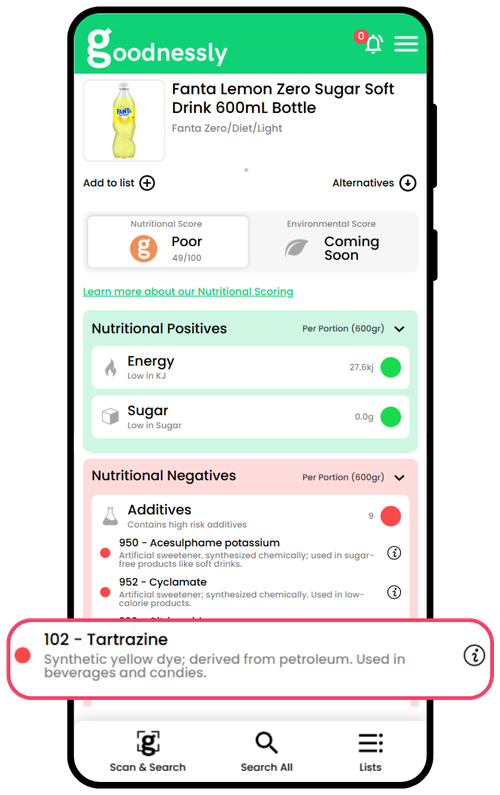
What is maltodextrin?
Maltodextrin is made by cooking starch with acid and/or enzymes, then purifying and drying it. The US defines it as a non-sweet saccharide polymer of glucose units with a dextrose equivalent (DE) below 20; more broken-down products are called glucose syrup solids. Your body digests it much like other starches and sugars, into glucose. “Resistant maltodextrin” is a different, fibre-type ingredient.
What's it used for?
- Bulking and carrying flavours and sweeteners
- Adding body and mouthfeel
- Quick-energy carbohydrate in sports drinks and gels
- Helping powders dissolve and flow
Where you'll find maltodextrin on the shelf
Look for it in powders, mixes and seasoned foods.
Is maltodextrin safe? What the research says
Regulators consider maltodextrin safe to eat, and there is no ADI because it is digested as a carbohydrate. Studies indicate it has a high glycaemic index, so it can raise blood glucose quickly, which is useful for athletes but worth knowing if you’re managing blood sugar. Some laboratory and animal research has looked at maltodextrin and gut bacteria, but this hasn’t been confirmed in human studies.
| Region | Status | What this means |
|---|---|---|
| AU/NZ Australia & New Zealand (FSANZ) | Permitted (food ingredient) | A food ingredient, listed by name. Included in the Code’s definition of “sugars” (Standard 1.1.2) and counts as an added sugar for “no added sugar” claims. |
| EU European Union (EFSA) | Permitted (food ingredient) | A food ingredient, not an additive. Wheat-based maltodextrins are exempt from gluten allergen labelling (Regulation (EU) No 1169/2011, Annex II). |
| US United States (FDA) | GRAS | GRAS under 21 CFR 184.1444, defined as having a dextrose equivalent below 20. |
Maltodextrin has no E-number. It is different from dextrin (1400), a roasted starch additive.
- FSANZ, December 2023: Proposal P1062 defined “added sugars” for “no added sugar” claims, including maltodextrin. Food businesses have until December 2027 to comply.
This section is checked periodically rather than continuously — if you're reading this well after the date above, it's worth confirming nothing has changed before citing it.
Who might want to limit or avoid it
- People managing blood glucose, such as those with diabetes
- People with coeliac disease, who should check the source if it is made from wheat
- Anyone cutting back on added sugars
Goodnessly rates maltodextrin Moderate Risk. It is a permitted, widely used ingredient, but it is a rapidly digested carbohydrate that counts as an added sugar in Australia and New Zealand.
How to spot it on a label
Look out for:
- Maltodextrin
- Maltodextrin (wheat), (corn) or (tapioca)
- Starch hydrolysate
- Corn syrup solids, a close relative
Always check the ingredient list, as the same ingredient can be listed under different names.
Related additives
Frequently asked questions
Is maltodextrin a sugar?
It is a carbohydrate made from starch, not table sugar, but the Food Standards Code includes it in the definition of ‘sugars’ and it counts as an added sugar for ‘no added sugar’ claims in Australia and New Zealand.
Is maltodextrin gluten free?
Most maltodextrin is made from corn, tapioca or potato. Wheat-based maltodextrin is highly processed and the EU exempts it from gluten allergen labelling, but people with coeliac disease should check the source and the allergen statement.
Why is maltodextrin in sports drinks?
It is a quickly digested carbohydrate that is less sweet than sugar, so it can supply energy without making a drink taste overly sweet.
How does Goodnessly rate maltodextrin?
Goodnessly rates maltodextrin as Moderate Risk. It is permitted and widely used, but it is a rapidly digested carbohydrate that counts as an added sugar in Australia and New Zealand.
Don't decode labels by hand
Scan any product with the Goodnessly app to instantly see its full additive breakdown, kept current as new research like this comes to light.
Download our app to check additives in everyday foods