
What is E123?
Amaranth — a synthetic red-purple dye banned in the United States since 1976 over cancer-risk findings, still permitted in a narrow list of foods in Australia and the EU under a much stricter modern intake limit.
Amaranth (E123) is a synthetic azo dye that produces a deep bluish-red colour, unrelated to the amaranth grain despite the shared name. The US FDA banned it in 1976 after animal studies suggested a possible cancer risk at high doses. Australia's FSANZ and the EU's EFSA still permit it, but only in a short list of specific foods such as some alcoholic beverages, caviar and cured fish, and EFSA cut its Acceptable Daily Intake sharply in 2010 after re-examining the underlying rat studies. Goodnessly rates it Avoid.
Download our app to check additives in everyday foods
Read the FAQ →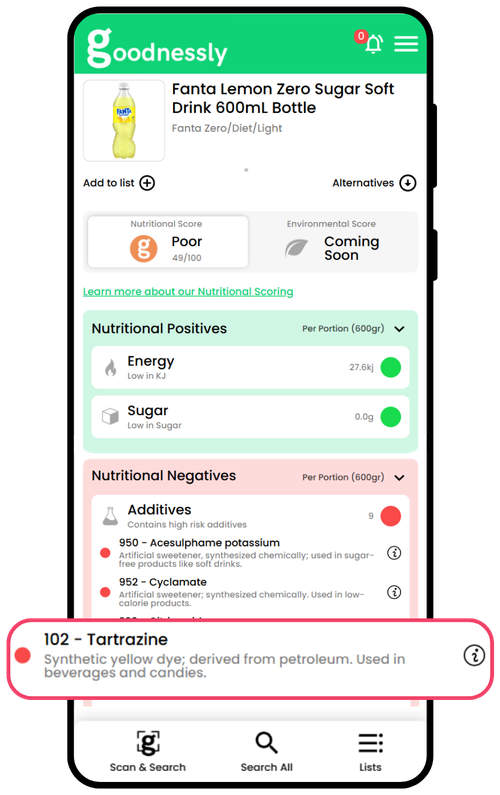
What is amaranth?
Amaranth is a synthetic azo dye, chemically unrelated to the amaranth plant it's named after, that produces a deep bluish-red or purple-red colour. It was one of the earliest widely used synthetic food dyes, valued by manufacturers for producing rich reds and purples that natural colourings struggled to match consistently. Its use has narrowed considerably since the 1970s: the US banned it outright, and both the EU and Australia restrict it to a specific, limited list of food categories rather than allowing general use, unlike more broadly permitted dyes such as Allura Red AC.
What's it used for?
- Colouring some alcoholic beverages, including certain aperitifs and cassis
- Used in caviar and some cured or smoked fish products
- Occasionally used in mustard and some confectionery in permitted markets
- Historically used more broadly before regulatory tightening narrowed its approved uses
Where you'll find 123 on the shelf
Its use is now tightly restricted, so it turns up in a much shorter, more specific list of products than most synthetic dyes.
Is amaranth safe? What the research says
Amaranth's regulatory story is one of the clearest three-way splits in this directory: a full US ban, and a narrow, tightly capped permission in Australia and the EU.
| Region | Status | What this means |
|---|---|---|
| AU/NZ Australia & New Zealand (FSANZ) | Permitted, restricted | Permitted only in a specific short list of foods with set maximum levels, not for general use. Must be declared by name or number on the ingredient list. |
| EU European Union (EFSA) | Permitted, restricted | Listed as E123, authorised only for a narrow list of foods such as certain alcoholic beverages, caviar and cured fish, at set maximum levels. EFSA's 2010 re-evaluation cut the Acceptable Daily Intake from 0.8 to 0.015 milligrams per kilogram of body weight per day. |
| US United States (FDA) | Banned | Banned since 1976 following a 1971 Soviet study and the FDA's own follow-up testing, which found a statistically significant increase in malignant tumours in female rats at high doses. Allura Red AC (E129) largely replaced it in US products. |
The lowered EU Acceptable Daily Intake followed EFSA reinterpreting the key long-term rat study's findings as a lowest-observed-adverse-effect level rather than a true no-effect level, and its 2010 review found that heavy consumers of some permitted aperitif drinks could exceed even the new, much stricter limit.
- EFSA's 2010 re-evaluation: the Acceptable Daily Intake for amaranth was cut more than 50-fold, from 0.8 to 0.015 milligrams per kilogram of body weight per day, after a fresh look at long-term rat toxicity data.
- US ban remains in place: amaranth has stayed banned in the United States since 1976, with Allura Red AC (E129) continuing as its main synthetic replacement in US-market products.
This section is checked periodically rather than continuously — if you're reading this well after the date above, it's worth confirming nothing has changed before citing it.
Who might want to limit or avoid it
- Anyone who prefers to avoid synthetic azo dyes generally, given amaranth's US ban and the scale of the EU's 2010 intake reduction
- Regular consumers of the specific product categories where it's still permitted, such as certain aperitif drinks, cured fish or caviar, given EFSA's finding that heavy users of some of these products could exceed even the lowered intake limit
- Anyone with a known sensitivity to azo dyes, which as a group have been associated with allergy-type reactions in a small percentage of people
Goodnessly rates E123 Avoid. It remains banned outright in the United States, and while Australia and the EU still permit it for a narrow list of foods, the scale of the 2010 EFSA intake reduction and the continued US ban place it in our highest-caution category.
How to spot it on a label
Amaranth is a legally restricted colour, so it's usually declared precisely where it's used. Look out for:
- Amaranth
- 123 or E123
- "Colour (123)" in the ingredients list
Some aperitif-style drinks, caviar and cured fish are the most common places to find it in Australia.
Related additives
Frequently asked questions
Is amaranth the food colour the same as the amaranth grain?
No, they're unrelated beyond the name. Amaranth the food colour is a synthetic azo dye that produces a deep bluish-red shade, named after the reddish colour of the amaranth plant. Amaranth the grain is a completely different, naturally nutritious pseudo-cereal and contains no connection to the dye.
Why is amaranth banned in the United States but not in Australia or the EU?
The FDA banned amaranth in 1976 after a 1971 Soviet study raised concerns about cancer risk in rats, and the FDA's own follow-up testing found a statistically significant increase in malignant tumours in female rats at high doses. The EU and Australia's FSANZ reviewed similar and later evidence and concluded the dye remains acceptable for a narrow list of specific foods at controlled levels, rather than banning it outright.
What is the safe intake limit for amaranth?
EFSA substantially lowered amaranth's Acceptable Daily Intake in 2010, from a previous 0.8 milligrams per kilogram of body weight per day down to 0.015 milligrams per kilogram of body weight per day, after reinterpreting a 2-year rat study's findings as a lowest-observed-adverse-effect level rather than a no-effect level. EFSA's analysis found that heavy consumers of some aperitif-style drinks could exceed even this new, much stricter limit.
Does Goodnessly rate E123 as safe, caution, or avoid?
Goodnessly rates E123 (Amaranth) as Avoid. It remains banned in the United States on cancer-risk grounds first raised in the 1970s, and while it's still permitted in Australia and the EU for a narrow list of foods, its Acceptable Daily Intake was cut dramatically in 2010 after a fresh EFSA review of the underlying animal studies.
Don't decode labels by hand
Scan any product with the Goodnessly app to instantly see its full additive breakdown, kept current as new research like this comes to light.
Download our app to check additives in everyday foods
At Goodnessly we aim to educate and empower individuals to make informed choices about everyday products.
© 2024 . All rights reserved.
Facebook
Instagram
X
TikTok