
What is E129?
Allura Red AC — the synthetic red dye also sold as Red 40, one of the "Southampton Six" colours the EU requires a children's-hyperactivity warning label on, and a dye the US food industry has agreed to voluntarily phase out by the end of 2026.
Allura Red AC (E129), also known as FD&C Red No. 40 or simply Red 40, is a synthetic azo dye used to give foods and drinks a bright red colour. It's permitted in Australia, New Zealand, the EU and the US, but it's one of the "Southampton Six" colours the EU requires a mandatory hyperactivity warning label on, following a 2007 UK study. In April 2025 the FDA and US Department of Health and Human Services announced a voluntary industry agreement to phase it out of the US food supply by the end of 2026. Goodnessly rates it Avoid.
Download our app to check additives in everyday foods
Read the FAQ →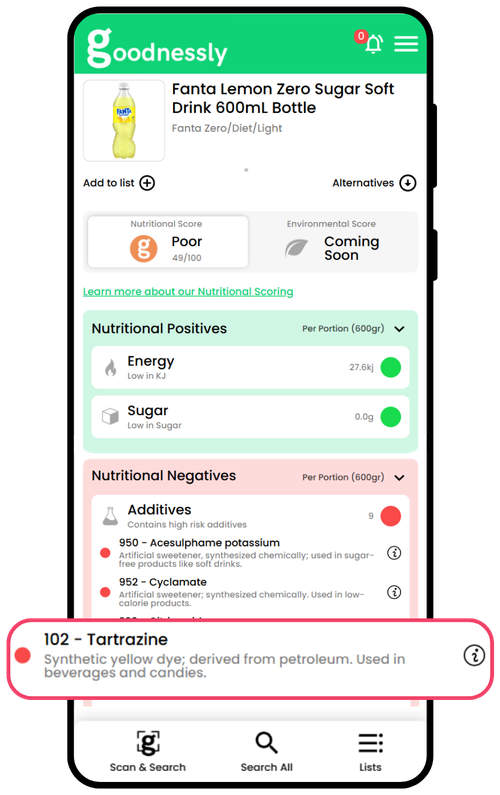
What is Allura Red AC?
Allura Red AC is a synthetic azo dye that produces a bright, warm red colour, widely known in the US as FD&C Red No. 40 or simply Red 40. It largely replaced the older dye amaranth (E123) in US products after that dye was banned in 1976, and has since become one of the most widely used synthetic red colours worldwide thanks to its vivid, stable colour and relatively low cost compared with natural alternatives.
What's it used for?
- Colouring soft drinks, cordials, sports and energy drinks
- Brightening lollies, gummies and other confectionery
- Adding colour to cake mixes, icing and desserts
- Colouring flavoured snacks, sauces and some cereals
- Used in some children's medications, vitamins and cosmetics
Where you'll find 129 on the shelf
Tends to hide in plain sight, wherever a product is a vivid, warm red that wouldn't occur naturally at that intensity.
Is Allura Red AC safe? What the research says
Allura Red AC's biggest controversy traces back to the 2007 Southampton Study, which examined mixtures of artificial colours, including Allura Red AC, combined with the preservative sodium benzoate, and found a possible link to increased hyperactivity in children. Regulators have responded very differently since.
| Region | Status | What this means |
|---|---|---|
| AU/NZ Australia & New Zealand (FSANZ) | Permitted | Must be declared by name or number (129). No hyperactivity warning label required — FSANZ found insufficient evidence of a causal link at permitted levels. |
| EU European Union (EFSA) | Permitted with warning | Must carry the label "may have an adverse effect on activity and attention in children" — part of the "Southampton Six" colours. EFSA's 2009 reassessment set an Acceptable Daily Intake of 7 milligrams per kilogram of body weight per day. |
| US United States (FDA) | Permitted — voluntary phase-out under way | Still approved as FD&C Red No. 40 and legal to use today. In April 2025 the FDA and HHS announced a voluntary industry agreement to phase Allura Red AC and five other petroleum-based dyes out of the food supply by the end of 2026 — not a formal ban. Several individual states have gone further with binding restrictions, mostly on school meals, ahead of that timeline. |
EFSA's 2015 exposure assessment found that intake estimates for Allura Red AC did not exceed its Acceptable Daily Intake across the population groups it examined, separate from the ongoing debate over the Southampton Study's hyperactivity findings.
- US phase-out announced (April 2025): the FDA and HHS announced a voluntary industry agreement to remove Allura Red AC and five other synthetic dyes from the US food supply by the end of 2026. Still legal to use as of publication — see the regulatory table above for the distinction from a formal ban.
- State-level restrictions continue to spread: several US states have introduced their own binding rules restricting Allura Red AC, mostly covering school meals, ahead of the industry's 2026 voluntary timeline.
This section is checked periodically rather than continuously — if you're reading this well after the date above, it's worth confirming nothing has changed before citing it.
Who might want to limit or avoid it
- Parents who notice changes in behaviour or attention after their child eats brightly coloured foods or drinks
- Anyone choosing to follow the more precautionary EU labelling approach, even though the warning isn't mandatory in Australia
- Anyone wanting to get ahead of the direction US regulators and manufacturers are already heading, given the 2025 voluntary phase-out announcement
Goodnessly rates E129 Avoid. It's permitted in Australia, the EU and the US, but its place in the EU's mandatory Southampton Six warning label and the US food industry's own move to phase it out by the end of 2026 place it in our highest-caution category.
How to spot it on a label
Allura Red AC can appear under a few different names, so it's easy to miss if you're scanning quickly. Look out for:
- Allura Red AC
- Red 40 / FD&C Red No. 40
- 129 or E129
- "Colour (129)" in the ingredients list
Drinks, lollies, desserts and brightly coloured snacks are the most common places to find it.
Related additives
Frequently asked questions
Is Allura Red AC the same as Red 40?
Yes. Allura Red AC, E129 and FD&C Red No. 40 all refer to the same synthetic red azo dye. Red 40 is the common US name, while Allura Red AC and E129 are the names used in Australia, New Zealand and the EU.
Why does the EU require a warning label on Allura Red AC but Australia doesn't?
Both regulators reviewed the same 2007 Southampton Study, which found a possible link between mixtures of artificial colours, including Allura Red AC, combined with the preservative sodium benzoate, and increased hyperactivity in some children. The EU took a precautionary approach and made a warning label mandatory for Allura Red AC and five related colours, known as the Southampton Six. FSANZ concluded the evidence wasn't strong enough to establish a causal link for the general population and did not introduce an equivalent requirement.
Is Allura Red AC being banned in the United States?
Not through a formal ban. In April 2025, the FDA and the US Department of Health and Human Services announced a voluntary industry agreement to phase Allura Red AC and several other petroleum-based synthetic dyes out of the food supply by the end of 2026. It remains legal to use as of publication, and several individual states have introduced their own binding restrictions, mostly covering school meals, ahead of that timeline.
Does Goodnessly rate E129 as safe, caution, or avoid?
Goodnessly rates E129 (Allura Red AC) as Avoid. It's permitted in Australia, the EU and the US, but its inclusion in the EU's mandatory Southampton Six hyperactivity warning label, combined with the US industry's own move to phase it out by the end of 2026, place it in our highest-caution category.
Don't decode labels by hand
Scan any product with the Goodnessly app to instantly see its full additive breakdown, kept current as new research like this comes to light.
Download our app to check additives in everyday foods