
What is E132?
Indigotine (indigo carmine) — a synthetic blue food colour, also known as FD&C Blue No. 2 in the US, permitted in Australia/NZ, the EU and the United States.
Indigotine (E132), also called indigo carmine, is a synthetic indigoid dye used to colour foods and drinks blue to bluish-purple. It is permitted in Australia, New Zealand, the EU and the United States (where it is certified as FD&C Blue No. 2). EFSA's 2014 re-evaluation kept an Acceptable Daily Intake of 5 milligrams per kilogram of body weight per day, but limited that ADI to high-purity material pending further data on a reported testicular finding in one study; a 2023 EFSA follow-up confirmed the same ADI for material meeting revised specifications and found no safety concern at reported use levels. Goodnessly still rates it Avoid as a synthetic colour with a historically contested purity dataset.
Download our app to check additives in everyday foods
Read the FAQ →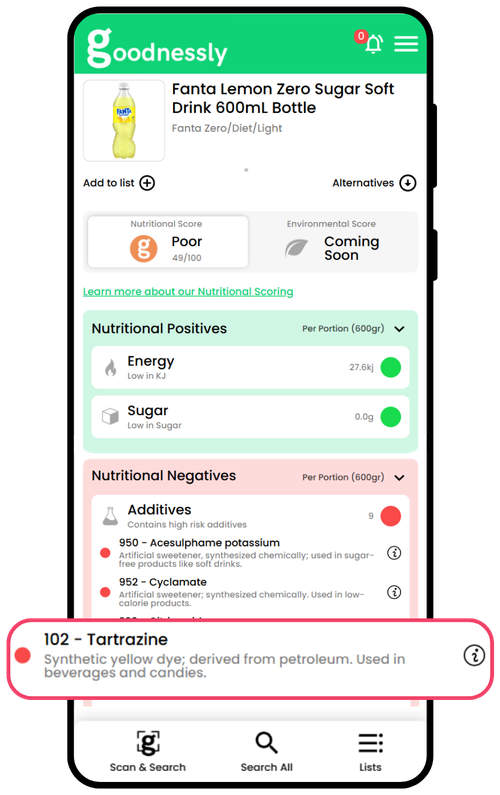
What is indigotine?
Indigotine is a synthetic indigoid dye (not an azo dye), produced by sulfonating indigo. On labels it may appear as indigotine, indigo carmine, 132, E132, or — on US-market products — FD&C Blue No. 2 / Blue 2. It is chemically distinct from Brilliant Blue FCF (E133), another common blue colour.
What's it used for?
- Blue colouring in confectionery, ice creams and desserts
- Colouring in soft drinks, cordials and some powdered drink mixes
- Used in some bakery decorations and icing
- Occasionally used in savoury products and dietary supplements where permitted
Where you'll find E132 on the shelf
It shows up wherever manufacturers want a stable synthetic blue — sweets, drinks and some decorated bakery items.
Is indigotine safe? What the research says
Indigotine is one of the few synthetic blues still authorised on both sides of the Atlantic. The scientific debate has centred on purity specifications and a single contested animal finding, not on a Southampton Six-style hyperactivity warning.
| Region | Status | What this means |
|---|---|---|
| AU/NZ Australia & New Zealand (FSANZ) | Permitted | Must be declared by name or number (132). Permitted under the Food Standards Code for specified food categories; no hyperactivity warning label is required in Australia or New Zealand. |
| EU European Union (EFSA) | Permitted; ADI 5 mg/kg | Authorised as E132. EFSA's 2014 re-evaluation confirmed an Acceptable Daily Intake of 5 milligrams per kilogram of body weight per day (aligned with JECFA), but applied it only to high-purity material matching the studies that underpinned the ADI, pending data on a reported testicular finding. In 2023 EFSA's follow-up confirmed the same ADI for indigo carmine disodium salts meeting revised specifications (at least 85% colouring matter) and concluded there is no safety concern at reported use levels and submitted analytical data. |
| US United States (FDA) | Approved (FD&C Blue No. 2) | Permanently listed as FD&C Blue No. 2 under 21 CFR 74.102 for foods generally (including dietary supplements), with batch certification required. Use must be consistent with current good manufacturing practice, except where a food standard of identity does not allow added colour. |
EFSA's 2014 opinion noted that, under a maximum-permitted-level exposure scenario, estimates for toddlers and children at the high level could exceed the ADI, while exposure estimates using reported use and analytical data did not show an exceedance for any population group. JECFA's 86th meeting (2018) confirmed its ADI of 0–5 milligrams per kilogram of body weight and concluded dietary exposure did not present a health concern.
- EFSA 2014 re-evaluation: confirmed the ADI of 5 milligrams per kilogram of body weight per day for indigo carmine, but limited applicability to high-purity material pending further data addressing a reported testicular finding in one study with unclear test-material identity.
- EFSA 2023 follow-up: a new 56-day dietary study did not reproduce those severe testicular findings; the Panel confirmed the ADI for indigo carmine (E132) disodium salts meeting proposed revised specifications (85% minimum colouring matter) and found no safety concern at reported use levels.
- Specification tightening: the 2023 opinion recommended modifications to EU specifications for E132, mainly lower limits for toxic elements, and further work on identification of unsulphonated aromatic amines.
This section is checked periodically rather than continuously — if you're reading this well after the date above, it's worth confirming nothing has changed before citing it.
Who might want to limit or avoid it
- Anyone who prefers to minimise synthetic dye intake in sweets, drinks and decorated bakery foods
- Parents comparing labels across markets — the same colour may appear as E132 / indigotine in AU/EU and as FD&C Blue No. 2 in the US
- People who have been advised by a clinician to limit particular food colours, or who notice that certain brightly coloured products seem associated with their own symptoms
Goodnessly rates E132 Avoid. Regulators in Australia/NZ, the EU and the US still permit indigotine within set limits, and EFSA's 2023 follow-up closed the main purity data gap — but as a synthetic colour with a historically contested dataset and child-exposure questions under maximum-use assumptions, it stays in our highest-caution category.
How to spot it on a label
E132 must be declared clearly. Look out for:
- Indigotine or indigo carmine
- 132 or E132
- Colour (132)
- FD&C Blue No. 2 / Blue 2 (US-market labels)
Most common in brightly coloured confectionery, soft drinks and decorated desserts.
Related additives
Frequently asked questions
What is Indigotine (E132) made from?
Indigotine (indigo carmine) is a synthetic indigoid dye made by sulfonating indigo. It is manufactured industrially and is not derived from plants, insects or minerals in the finished food-additive form.
Is Indigotine the same as Brilliant Blue FCF?
No. Indigotine (E132 / FD&C Blue No. 2) is an indigoid dye; Brilliant Blue FCF (E133 / FD&C Blue No. 1) is a different synthetic blue (a triarylmethane dye). Both can appear on labels as "blue" colouring, so check the number or full name.
Did EFSA change its mind on Indigotine?
EFSA's 2014 re-evaluation kept the Acceptable Daily Intake of 5 milligrams per kilogram of body weight per day but limited it to high-purity material pending data on a reported testicular finding. The 2023 follow-up confirmed the same ADI for material meeting revised specifications and concluded there is no safety concern at reported use levels. That closes the main data gap; it does not create a ban.
Does Goodnessly rate E132 as safe, caution or avoid?
Goodnessly rates E132 (Indigotine) as Avoid. It remains permitted in Australia/NZ, the EU and the US, but as a synthetic colour with a historically contested purity dataset and child-exposure questions under maximum-use assumptions, it sits in our highest-caution category.
Don't decode labels by hand
Scan any product with the Goodnessly app to instantly see its full additive breakdown, kept current as new research like this comes to light.
Download our app to check additives in everyday foods
At Goodnessly we aim to educate and empower individuals to make informed choices about everyday products.
© 2024 . All rights reserved.
Facebook
Instagram
X
TikTok