
What is E133?
Brilliant Blue FCF — a synthetic blue dye that the US FDA is now working with industry to phase out of the food supply entirely by 2027.
E133 (Brilliant Blue FCF, also called FD&C Blue No. 1) is a fully synthetic dye used to give food and drinks a vivid blue or teal colour. It remains legally permitted in Australia, the US and the EU, but EFSA has found that children can exceed the safe daily intake at higher consumption levels, and in April 2025 the FDA announced a voluntary industry phase-out targeting removal from the US food supply by the end of 2027. Goodnessly rates it Avoid.
Download our app to check additives in everyday foods
Read the FAQ →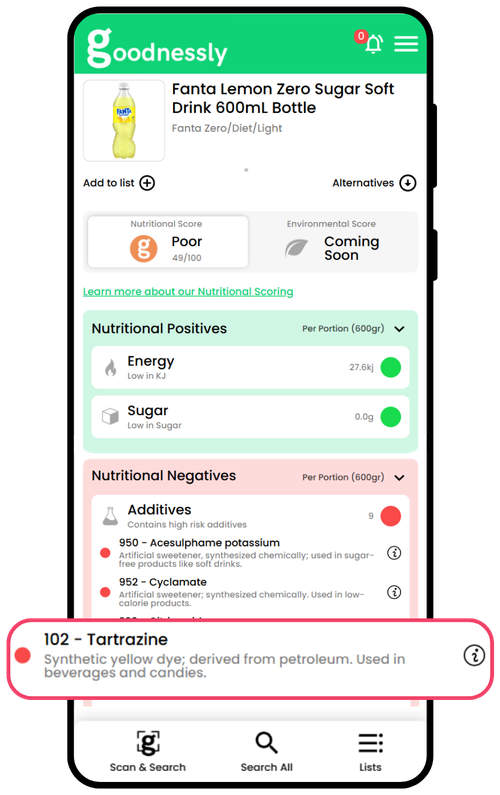
What is Brilliant Blue FCF?
Brilliant Blue FCF is a fully synthetic triarylmethane dye, produced entirely by chemical synthesis rather than extracted from any natural source. Only a small fraction (around 5%) is absorbed from the digestive tract when eaten, with roughly 96% excreted unchanged within about 36 hours — part of why regulators have historically considered its systemic toxicity risk low. It's sometimes combined with tartrazine (E102) or other yellow dyes to produce various shades of green, and a version bound to aluminium hydroxide (called "Blue 1 Lake") is used in oil-based or dry products where the standard water-soluble form won't work.
What's it used for?
- Colouring soft drinks and sports drinks
- Confectionery and lollies
- Frostings and gelatin desserts
- Ice pops and flavoured dairy products
- Some baked goods and breakfast pastries
Where you'll find 133 on the shelf
Common in brightly coloured drinks, sweets and desserts.
Is Brilliant Blue FCF safe? What the research says
Brilliant Blue FCF remains legally approved everywhere it's used, but the regulatory picture has shifted meaningfully in the last two years.
| Region | Status | What this means |
|---|---|---|
| AU/NZ Australia & New Zealand (FSANZ) | Permitted | Permitted as a food colour, must be declared by name or number on the ingredient list. |
| EU European Union (EFSA) | Permitted, ADI lowered | Listed as E133. EFSA's 2010 re-evaluation cut the Acceptable Daily Intake from 10mg to 6mg per kilogram of bodyweight per day, and found that children at higher consumption levels can exceed this limit. |
| US United States (FDA) | Permitted, phase-out announced | Listed as FD&C Blue No. 1. In April 2025, the FDA announced it's working with industry on a voluntary phase-out, targeting removal from the US food supply by the end of 2027. California has separately mandated its removal from public school foods by the same date. |
Only around 5% of an oral dose is absorbed from the gut, with roughly 96% excreted unchanged in faeces within 36 hours. Brilliant Blue FCF is not subject to the Southampton hyperactivity warning label required for several other synthetic colours (E102, E104, E110, E122, E124, E129) — the 2007 Southampton Study specifically found it wasn't a primary contributor to the hyperactivity effects observed with other dye combinations.
- FDA voluntary phase-out announced (2025): the FDA is working with US manufacturers to remove Brilliant Blue FCF from the food supply by the end of 2027, part of a broader push against synthetic dyes. The UK and EU have not announced equivalent action.
- Animal studies below the ADI: some animal studies have reported neurobehavioural changes in offspring and immune disruption at doses below the current Acceptable Daily Intake, prompting some reviewers to call for further research even though regulators haven't changed the approved status.
- Emerging gut-microbiome research: because dyes like Brilliant Blue FCF pass through the gut largely unabsorbed, researchers are increasingly studying whether they interact with gut bacteria before being excreted — an active area of investigation rather than a settled finding.
This section is checked periodically rather than continuously — if you're reading this well after the date above, it's worth confirming nothing has changed before citing it.
Who might want to limit or avoid it
- Parents of children who consume a lot of brightly coloured drinks and sweets, given EFSA's own finding that children can exceed the safe daily intake at higher consumption levels
- Anyone who follows FDA guidance closely, given the agency's own 2025 decision to work toward phasing this dye out of the food supply
- People with aspirin intolerance, who may be more prone to rare allergic-type reactions to synthetic dyes generally
- Anyone who prefers to avoid non-essential synthetic dyes on principle, since Brilliant Blue FCF serves a purely cosmetic function
Goodnessly rates E133 Avoid. It remains legally approved in Australia, the US and the EU, but the FDA's own move toward phasing it out, combined with children's ability to exceed the ADI and animal studies showing effects below that threshold, places it in our highest-caution category.
How to spot it on a label
E133 must be declared clearly. Look out for:
- Brilliant Blue FCF
- FD&C Blue No. 1 / Blue 1
- 133 or E133
- "Colour (133)" in the ingredients list
Soft drinks, confectionery and frostings are the most common places to find it.
Related additives
Frequently asked questions
Is E133 the same as FD&C Blue No. 1?
Yes — Brilliant Blue FCF, E133 and FD&C Blue No. 1 (or Blue 1) all refer to the same synthetic dye, just using the naming conventions of different regulatory systems.
Is Brilliant Blue FCF being banned?
Not banned outright, but the FDA announced in April 2025 that it's working with industry on a voluntary phase-out, targeting removal from the US food supply by the end of 2027. It remains legally permitted in Australia and the EU, with no equivalent phase-out announced in either.
Does E133 cause hyperactivity in children?
The well-known 2007 Southampton Study, which prompted warning labels on several other synthetic dyes, specifically found that Brilliant Blue FCF was not a primary contributor to the hyperactivity effects observed. It doesn't carry the Southampton warning label required for dyes like E102, E110 and E129.
Does Goodnessly rate E133 as safe, caution, or avoid?
Goodnessly rates E133 (Brilliant Blue FCF) as Avoid. It remains legally approved, but the FDA's own move toward phasing it out, EFSA's finding that children can exceed the safe daily intake, and animal studies showing effects below that threshold place it in our highest-caution category.
Don't decode labels by hand
Scan any product with the Goodnessly app to instantly see its full additive breakdown, kept current as new research like this comes to light.
Download our app to check additives in everyday foods