
What is E140?
Chlorophyll — the same green pigment that colours leaves and grass, extracted from plants to give food a natural green shade.
E140 (chlorophyll) is a natural green pigment extracted from green plants like spinach, nettles or alfalfa, the same pigment responsible for photosynthesis in every green leaf. It's used as a natural food colouring, and is considered very safe with no known health concerns at food-use levels. Goodnessly rates it Safe.
Download our app to check additives in everyday foods
Read the FAQ →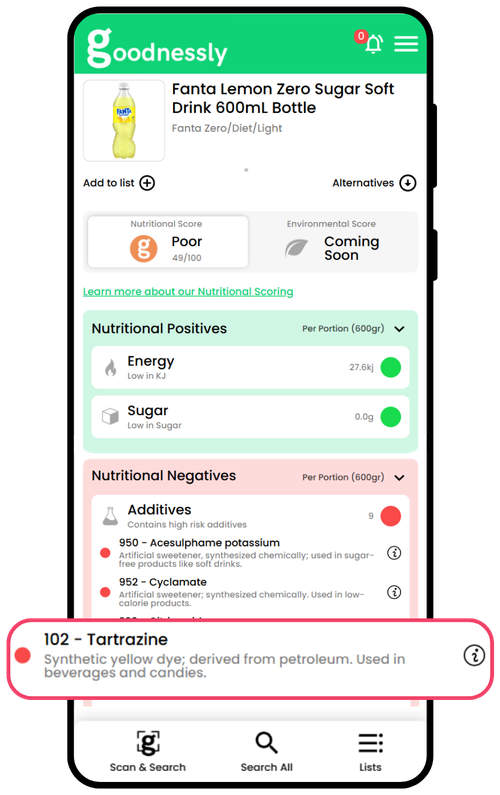
What is chlorophyll?
Chlorophyll is the pigment responsible for photosynthesis in plants, algae and cyanobacteria — it's what captures sunlight and converts it into chemical energy, and what gives leaves, grass and green vegetables their colour. As a food additive, it's extracted from green plant material like nettles, spinach or alfalfa. The natural form is somewhat unstable and can fade during processing, so a more stable version, chlorophyllin (a related compound), or chlorophyll-copper complex (E141) is sometimes used instead for products needing a more durable green.
What's it used for?
- Colouring confectionery and chewing gum a natural green
- Used in some liqueurs and beverages
- Colouring pasta and sauces
- Natural alternative to synthetic green dyes
Where you'll find 140 on the shelf
Anywhere a natural green colour is wanted.
Is chlorophyll safe? What the research says
Chlorophyll is one of the most familiar natural pigments in the world, with a clean regulatory record.
| Region | Status | What this means |
|---|---|---|
| AU/NZ Australia & New Zealand (FSANZ) | Permitted, no limit | Permitted at quantum satis (as much as needed for the intended purpose). |
| EU European Union (EFSA) | Permitted, no ADI | Listed as E140, with no numerical Acceptable Daily Intake needed. |
| US United States (FDA) | GRAS | Holds Generally Recognized As Safe status for general food use. |
Chlorophyll is present in every green vegetable in the human diet, and there's no meaningful difference in safety between the chlorophyll naturally present in spinach and the extracted version used as a colouring additive.
- No significant regulatory changes: chlorophyll's approval status has remained stable, reflecting its long, low-controversy safety record.
This section is checked periodically rather than continuously — if you're reading this well after the date above, it's worth confirming nothing has changed before citing it.
Who this matters to
- No population group has a specific safety-based reason to limit E140 at typical food-additive levels
Goodnessly rates E140 Safe. It's one of the most familiar natural pigments in the world, present in every green vegetable you eat.
How to spot it on a label
E140 is usually declared clearly. Look out for:
- Chlorophyll
- 140 or E140
- "Colour (140)" in the ingredients list
Related additives
Frequently asked questions
Is E140 the same chlorophyll found in plants?
Yes — E140 is extracted directly from green plant material like nettles, spinach or alfalfa, and is chemically the same pigment responsible for photosynthesis in every green leaf.
Why does chlorophyll sometimes fade in food?
Natural chlorophyll is somewhat unstable and can degrade with heat, light or acidic conditions during processing. For products needing a more durable green, a related, more stable compound like chlorophyllin or chlorophyll-copper complex (E141) is sometimes used instead.
Does Goodnessly rate E140 as safe, caution, or avoid?
Goodnessly rates E140 (Chlorophyll) as Safe. It's one of the most familiar natural pigments in the world, present in every green vegetable you eat.
Don't decode labels by hand
Scan any product with the Goodnessly app to instantly see its full additive breakdown, kept current as new research like this comes to light.
Download our app to check additives in everyday foods