
What is E141?
Chlorophyll-copper complex — a more stable version of plant chlorophyll, engineered to hold its green colour under conditions that would fade the natural pigment.
E141 (chlorophyll-copper complex) is made by replacing the magnesium at the centre of a chlorophyll molecule with copper, producing a much more stable green pigment than plain chlorophyll (E140). This modification lets it hold its colour through processing, heat and storage conditions that would otherwise cause natural chlorophyll to fade or turn brown. Goodnessly rates it Safe.
Download our app to check additives in everyday foods
Read the FAQ →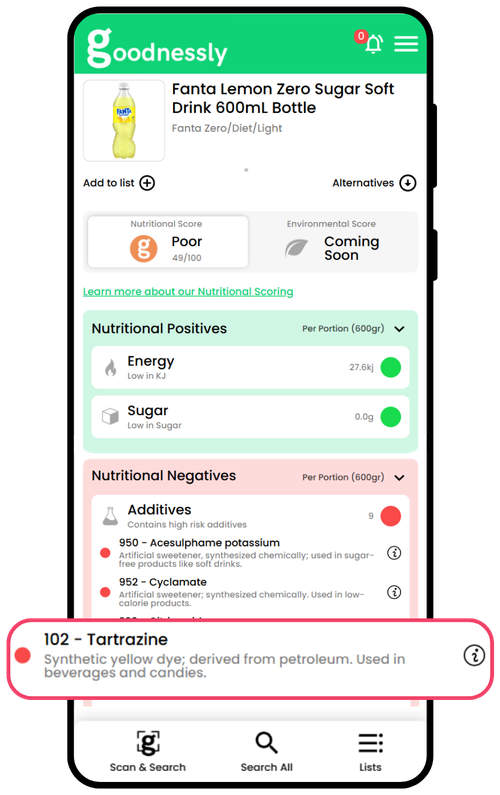
What is chlorophyll-copper complex?
Chlorophyll-copper complex is made by treating natural chlorophyll, extracted from plants like nettles or grass, in a way that replaces its central magnesium atom with a copper atom. This small structural change dramatically improves the pigment's stability, letting it withstand heat, light and the acidic conditions common in processed food, which plain chlorophyll doesn't tolerate well. Manufacturers reach for this modified version specifically when a product needs a reliable, long-lasting green rather than the fading, natural chlorophyll green covered on our E140 page.
What's it used for?
- Colouring processed vegetables and pickles
- Used in some confectionery and chewing gum
- Colouring soups and sauces requiring a stable green
- Alcoholic beverages and liqueurs
Where you'll find 141 on the shelf
Chosen wherever a stable green colour needs to survive processing.
Is chlorophyll-copper complex safe? What the research says
Chlorophyll-copper complex has a clean regulatory record, with the main consideration being the small amount of copper it introduces.
| Region | Status | What this means |
|---|---|---|
| AU/NZ Australia & New Zealand (FSANZ) | Permitted | Permitted as a food colour with set maximum levels in most categories. |
| EU European Union (EFSA) | Permitted, ADI set | Listed as E141. EFSA's re-evaluation set an Acceptable Daily Intake, taking into account the copper content of the compound alongside overall dietary copper exposure. |
| US United States (FDA) | Permitted | Permitted for use in specific food categories under FDA colour additive regulations. |
Copper is an essential trace mineral the body needs in small amounts, and the quantity introduced by E141 at typical use levels is minor relative to total dietary copper intake from other food sources.
- No significant regulatory changes: chlorophyll-copper complex's approval status has remained stable, reflecting its long, low-controversy safety record.
This section is checked periodically rather than continuously — if you're reading this well after the date above, it's worth confirming nothing has changed before citing it.
Who this matters to
- People with Wilson's disease or another condition affecting copper metabolism, who may be advised to monitor dietary copper sources generally
- Otherwise, no population group has a specific safety-based reason to limit E141
Goodnessly rates E141 Safe. It's a well-established, more stable variant of the chlorophyll pigment naturally present in every green plant, with a clean regulatory record.
How to spot it on a label
E141 is usually declared clearly. Look out for:
- Chlorophyll-copper complex
- Copper chlorophyllin
- 141 or E141
- "Colour (141)" in the ingredients list
Related additives
Frequently asked questions
Why use E141 instead of plain chlorophyll (E140)?
Plain chlorophyll fades and can turn brown under heat, light or acidic conditions common in processed food. Replacing its central magnesium atom with copper makes E141 far more stable, letting it hold its green colour through processing that would degrade natural chlorophyll.
Does E141 add meaningful copper to food?
Only a small amount, relative to total dietary copper intake from other sources. Copper is also an essential trace mineral the body needs, and EFSA's Acceptable Daily Intake for E141 takes overall copper exposure into account.
Does Goodnessly rate E141 as safe, caution, or avoid?
Goodnessly rates E141 (Chlorophyll-Copper Complex) as Safe. It's a well-established, more stable variant of the chlorophyll pigment naturally present in every green plant, with a clean regulatory record.
Don't decode labels by hand
Scan any product with the Goodnessly app to instantly see its full additive breakdown, kept current as new research like this comes to light.
Download our app to check additives in everyday foods