
What is E1402?
A modified starch treated with alkali instead of acid, used to fine-tune texture in sauces, soups and frozen meals.
E1402 (alkaline treated starch) is made by treating native starch with an alkali such as sodium hydroxide, changing its thickening properties. Regulators consider it well reviewed and low-risk, with no formal daily intake limit set anywhere. Goodnessly rates it Caution, in line with how modified starches as a group are treated.
Download our app to check additives in everyday foods
Read the FAQ →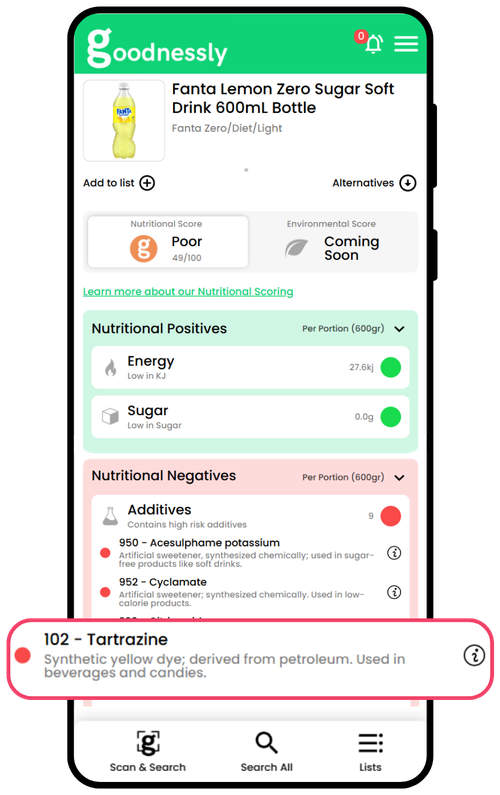
What is E1402?
E1402 is made by treating native starch (typically from maize, potato or wheat) with an inorganic alkali such as sodium hydroxide (lye) or potassium hydroxide, under controlled conditions. This "alkali thinning" process changes the starch's molecular structure, altering how it thickens and behaves when mixed with water and heated. Interestingly, EU food law technically doesn't classify starch modified only by acid or alkali treatment as a food additive in the strictest sense, though it's still tracked and assigned an INS number (1402) internationally.
What's it used for?
- Thickening sauces, soups and gravies
- Stabilising frozen meals through freeze-thaw cycles
- Improving texture in salad dressings
- Used in baked goods for consistent texture
Where you'll find 1402 on the shelf
Anywhere a product needs to hold its texture through freezing, reheating or processing.
Is E1402 safe? What the research says
Alkaline treated starch belongs to the same well-reviewed modified-starch family as several other additives in this directory.
| Region | Status | What this means |
|---|---|---|
| AU/NZ Australia & New Zealand (FSANZ) | Permitted | Permitted as a thickener and stabiliser with no specific quantity restriction in most food categories. |
| EU European Union (EFSA) | Permitted, no ADI | Listed under INS 1402. EFSA's review of the modified starch family concluded no numerical Acceptable Daily Intake was needed, finding no safety concern at the levels used in food. EU law technically treats starch modified only by acid or alkali as outside the strict food additive definition, though it remains internationally tracked. |
| US United States (FDA) | GRAS | Holds Generally Recognized As Safe status under 21 CFR 172.892 for use as a direct food additive. |
Like other modified starches, alkaline treated starch is digested similarly to ordinary dietary starch. The alkali treatment is neutralised during processing, and no meaningful residue remains in the finished ingredient.
- No significant regulatory changes: alkaline treated starch has been reviewed alongside the broader modified starch family, with no restrictions introduced since.
This section is checked periodically rather than continuously — if you're reading this well after the date above, it's worth confirming nothing has changed before citing it.
Who this matters to
- People with coeliac disease or a wheat allergy — E1402 can occasionally be derived from wheat starch, and generic "modified starch" labelling won't tell you the source
- Anyone avoiding genetically modified ingredients, since maize is a common raw material
- Otherwise, no population group has a specific safety-based reason to limit E1402
Goodnessly rates E1402 Caution, consistent with how modified starches are treated as a group. The underlying safety data is well established, with the caution reflecting sourcing and processing questions rather than any identified toxicological risk.
How to spot it on a label
E1402 is often declared generically. Look out for:
- Alkaline treated starch
- Modified starch
- 1402 or E1402
- "Modified wheat starch" if wheat-derived (an allergen declaration, not a different additive)
Sauces, soups and frozen meals are the most common places to find it.
Related additives
Frequently asked questions
Is E1402 the same as modified starch?
E1402 is one specific type of modified starch, alkaline treated starch. Ingredient lists often just say "modified starch" without specifying which variant is used.
What alkali is used to make E1402?
Typically sodium hydroxide (lye) or potassium hydroxide, applied to native starch under controlled conditions. The alkali is neutralised during production, leaving no meaningful residue in the finished ingredient.
Is E1402 gluten-free?
Usually, but not always. It's most commonly made from maize or potato starch, both naturally gluten-free. It can occasionally be made from wheat starch, in which case it must be declared as "modified wheat starch."
Does Goodnessly rate E1402 as safe, caution, or avoid?
Goodnessly rates E1402 (Alkaline Treated Starch) as Caution, consistent with how modified starches are treated as a group. Regulatory reviews found no safety concern and no need for a formal daily intake limit.
Don't decode labels by hand
Scan any product with the Goodnessly app to instantly see its full additive breakdown, kept current as new research like this comes to light.
Download our app to check additives in everyday foods