
Additive 225: what is potassium sulphite?
Also labelled: Potassium sulphite · Potassium sulfite · Preservative 225 · INS 225
A sulphite preservative and antioxidant, part of the sulphur dioxide group.
Potassium sulphite (225) is a sulphite preservative that releases sulphur dioxide to stop browning and microbial spoilage. It is permitted in Australia and New Zealand, but it is not on the EU additive list and has no US food listing. Goodnessly rates it Hazardous Risk.
Permitted in Australia and New Zealand (FSANZ) but not approved in the EU or the US. The EU authorises other sulphites, such as potassium metabisulphite (E224) and potassium bisulphite (E228), but not potassium sulphite. We found no US food listing for it.
Download our app to check additives in everyday foods
Read the FAQ →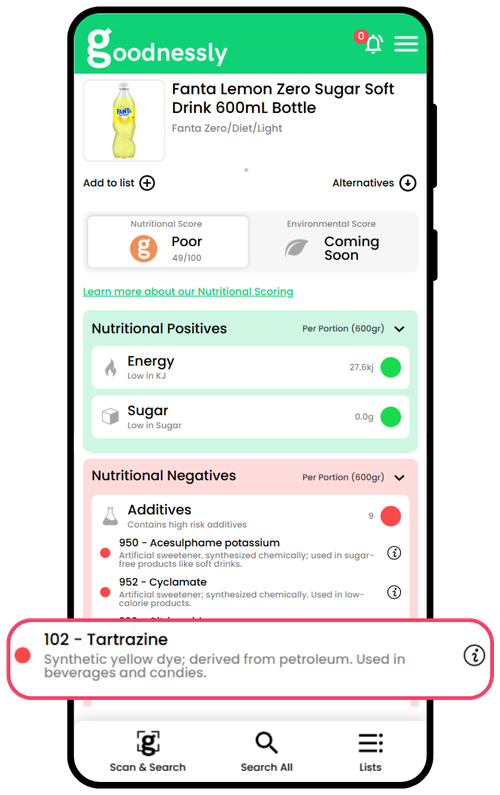
What is potassium sulphite?
Sulphites (220 to 228) are a family of sulphur-based preservatives. Potassium sulphite is one form. Its effect is measured as sulphur dioxide.
What's it used for?
- Preserving wine
- Dried fruit
- Some sausages and processed meats
- Some soft drinks and cordials
Where you'll find potassium sulphite on the shelf
Sulphites must be declared on labels in Australia and New Zealand when present at 10 mg/kg or more.
Is potassium sulphite safe? What the research says
Sulphites are associated with asthma-like and allergic-type reactions in some sensitive people. This is why FSANZ requires added sulphites at 10 mg/kg or more to be declared. JECFA assesses sulphites as a group, expressed as sulphur dioxide.
| Region | Status | What this means |
|---|---|---|
| AU/NZ Australia & New Zealand (FSANZ) | Permitted | Permitted within the sulphur dioxide and sulphites group under Schedule 15. It must be declared at 10 mg/kg or more. |
| EU European Union (EFSA) | Not authorised | Not on the Union list. Other sulphites (E220 to E224, E226 to E228) are authorised. |
| US United States (FDA) | Not permitted | No 21 CFR food listing for potassium sulfite. Potassium bisulfite and metabisulfite are GRAS. |
The FSANZ declaration requirement applies to all added sulphites, whatever their form.
- Labelling: FSANZ Standard 1.2.3 requires sulphites at 10 mg/kg or more to be declared.
This section is checked periodically rather than continuously — if you're reading this well after the date above, it's worth confirming nothing has changed before citing it.
Who might want to limit or avoid it
- People with asthma or sulphite sensitivity (talk to your doctor)
- Anyone limiting preservatives
- Wine and dried fruit lovers checking labels
Goodnessly rates 225 Hazardous Risk. Sulphites are associated with reactions in sensitive people, and this form is not approved in the EU or US.
How to spot it on a label
Look out for:
- Potassium sulphite
- Preservative (225)
- “Contains sulphites”
Always check the ingredient list, as the same ingredient can be listed under different names.
Related additives
Frequently asked questions
Is potassium sulphite the same as sulphur dioxide?
It is a sulphite salt that releases sulphur dioxide, so the two are grouped together for limits and labelling.
Is 225 allowed in the EU and US?
No. It is not on the EU list and has no US food listing, although other sulphites are allowed in both. It is permitted in Australia and New Zealand.
Who should avoid sulphites?
Some people with asthma or sulphite sensitivity react to sulphites. Talk to your doctor if you think you are affected.
How does Goodnessly rate 225?
Goodnessly rates 225 (Potassium sulphite) as Hazardous Risk. Sulphites are associated with reactions in sensitive people, and this form is not approved in the EU or US.
Don't decode labels by hand
Scan any product with the Goodnessly app to instantly see its full additive breakdown, kept current as new research like this comes to light.
Download our app to check additives in everyday foods