
What is E250?
Sodium nitrite — a curing agent and antimicrobial preservative used mainly in processed meats, permitted with strict limits in Australia/NZ, the EU and the US, and placed in our highest-caution category because of nitrosamine and processed-meat context.
Sodium nitrite (E250) is used to cure meats: it helps fix the pink colour, contributes to flavour, and is authorised in part to inhibit the growth of Clostridium botulinum. FSANZ, EFSA and the US FDA all permit it within set maximum levels. EFSA’s 2017 re-evaluation of E249/E250 set an Acceptable Daily Intake of 0.07 mg nitrite ion/kg body weight/day (based on methaemoglobin effects) and estimated additive-only exposure stayed within that ADI for most people, with a slight exceedance possible for highly exposed children. Epidemiological studies have linked dietary nitrite and nitrite-plus-nitrate from processed meat with certain cancers; IARC separately classified the consumption of processed meat as Group 1 — that classification applies to the food category, not uniquely to E250 alone. Goodnessly rates it Avoid.
Download our app to check additives in everyday foods
Read the FAQ →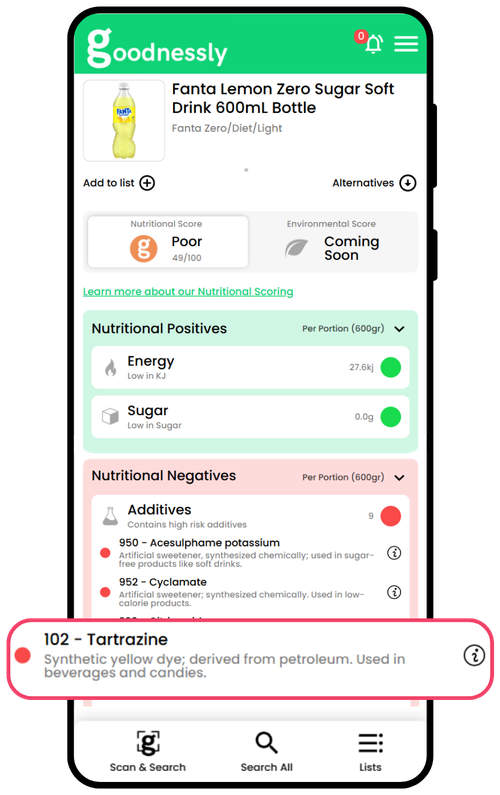
What is sodium nitrite?
Sodium nitrite is the sodium salt of nitrous acid (INS/E 250). In food it is used as a curing agent and antimicrobial preservative, most often in processed meat, poultry and some fish products. It helps retain the characteristic pink-red cured colour, contributes to the cured flavour, and is authorised in part because nitrites can inhibit Clostridium botulinum growth under curing conditions. It is evaluated together with potassium nitrite (E249); related nitrate salts (E251/E252) can convert to nitrite in the body and are often discussed in the same regulatory reviews.
What's it used for?
- Curing bacon, ham, frankfurters and other processed meats
- Colour retention and flavour development in cured products
- Antimicrobial preservative role, including botulism-risk reduction in certain meat products
- Used only where Schedule 15 (AU/NZ), EU category limits or US CFR permissions allow it
Where you'll find 250 on the shelf
Sodium nitrite is concentrated in cured and processed meats rather than everyday soft drinks or sauces — always check the ingredients list on packaged meat products.
Is sodium nitrite safe? What the research says
Regulators in Australia/NZ, the EU and the US all still permit sodium nitrite within set limits, in part for its technological role in cured meats. The shopper debate sits between that permitted use and longer-running questions about nitrosamines, methaemoglobin, and the separate IARC classification of processed-meat consumption.
| Region | Status | What this means |
|---|---|---|
| AU/NZ Australia & New Zealand (FSANZ) | Permitted | Listed as 249/250 (nitrites, potassium and sodium salts) in Schedule 15 of the Food Standards Code for specified meat categories — for example 125 mg/kg in cured, dried and many processed comminuted meats, and 50 mg/kg in commercially sterile canned cured meat (totals of nitrates and nitrites calculated as sodium nitrite, unless a contrary intention appears). Must be declared by name or code number on the ingredients list. |
| EU European Union (EFSA) | Permitted; ADI 0.07 | Authorised as E250 under Regulation (EC) No 1333/2008 for specified meat (and related) categories at maximum levels. EFSA’s 2017 re-evaluation of E249/E250 derived an ADI of 0.07 mg nitrite ion/kg body weight/day using a benchmark-dose approach on methaemoglobin. Exposure from the additive alone was estimated within the ADI for the general population, with a slight exceedance possible for children at the highest percentile. Commission Regulation (EU) 2023/2108 later tightened several maximum levels for nitrites in meat products (applicable from October 2025). |
| US United States (FDA) | Permitted | Permitted as a food additive under 21 CFR 172.175 for specified cured fish and home meat-curing uses (with finished-product limits such as 200 ppm sodium nitrite in certain cured products). Prior-sanctioned curing uses in red meat and poultry are also reflected in 21 CFR 181.34; USDA FSIS rules additionally limit nitrite in commercial cured meat and bacon. |
JECFA (2002) established an ADI of 0–0.07 mg/kg body weight/day expressed as nitrite ion, applying to all sources of intake but not to infants below three months of age. That numerical ADI matches EFSA’s 2017 figure; JECFA additionally flagged that the ADI does not cover the youngest infants, reflecting historical methaemoglobinaemia caution around nitrite.
- EFSA 2017 nitrite ADI: the Panel derived 0.07 mg nitrite ion/kg bw/day for E249/E250 from methaemoglobin effects, found no indication of in-vivo genotoxicity for the nitrites themselves, and estimated additive-only exposure within the ADI for most consumers, with a slight exceedance possible for highly exposed children. The Panel also discussed endogenous and exogenous nitrosamines and reported some epidemiological evidence linking dietary nitrite with gastric cancers and nitrite-plus-nitrate from processed meat with colorectal cancers.
- EU maximum-level update (2023/2108): risk managers reduced several authorised maximum levels for nitrites in meat products (Regulation (EU) 2023/2108), with the new limits applying from 9 October 2025 — a further tightening of use, not a ban.
- IARC processed meat (context): in 2015 IARC classified the consumption of processed meat as Group 1 (carcinogenic to humans), based on epidemiological evidence linking processed-meat consumption with colorectal cancer. Processed meat is defined by processes such as salting, curing, fermentation or smoking. That evaluation addresses the food category as consumed; it is not a stand-alone monographic classification of sodium nitrite (E250) alone. Many processed meats contain nitrite, but other factors in the category are also part of the evidence base.
- Methaemoglobinaemia / infant ADI note: elevated methaemoglobin is the effect EFSA used to set the ADI. JECFA states its nitrite ADI does not apply to infants below three months. FSANZ’s Australian survey work has discussed methaemoglobin risk in the context of total dietary nitrate/nitrite and reported that estimated exposures in the surveyed populations were below levels associated with elevated methaemoglobin in the studies it reviewed — a calm both-sides note, not a claim that every historical infant case is irrelevant.
This section is checked periodically rather than continuously — if you're reading this well after the date above, it's worth confirming nothing has changed before citing it.
Who might want to limit or avoid it
- People who already limit processed meats for cancer-risk reasons, given IARC’s classification of processed-meat consumption and EFSA’s discussion of epidemiological links involving dietary nitrite and nitrite-plus-nitrate from processed meat
- Parents of young children who eat cured meats frequently, given EFSA’s note that highly exposed children might slightly exceed the additive ADI, and JECFA’s statement that its ADI does not apply to infants under three months
- Anyone who prefers to minimise curing agents and wants to choose fresh or uncured alternatives when available
- People who have been advised by a clinician to limit nitrites or nitrosamine-related exposures
Goodnessly rates E250 Avoid. Regulators still permit sodium nitrite within set limits — partly for colour, flavour and antimicrobial reasons in cured meats — but the combination of nitrosamine and epidemiological questions, the separate IARC processed-meat classification, and the methaemoglobin-based ADI (with an infant carve-out at JECFA) is enough for us to place it in our highest-caution category rather than everyday-use.
How to spot it on a label
Sodium nitrite is usually declared clearly when it is used as a curing agent or preservative. Look out for:
- Sodium nitrite
- 250 or E250
- "Preservative (250)" or "Preservative (sodium nitrite)" in the ingredients list
- Related curing salts: potassium nitrite (249), sodium nitrate (251), potassium nitrate (252); curing accelerators such as sodium ascorbate (301) or sodium erythorbate (316) may appear alongside
Bacon, ham, frankfurters and other cured meats are among the most common places to find it in Australia.
Related additives
Frequently asked questions
Is sodium nitrite permitted in Australia and New Zealand?
Yes. FSANZ lists sodium nitrite as additive 250 with potassium nitrite (249) in Schedule 15 of the Food Standards Code for specified meat categories at maximum permitted levels (for example 125 mg/kg in many cured and processed meats, and 50 mg/kg in commercially sterile canned cured meat). Permission does not mean every consumer will choose to eat it.
Did IARC classify sodium nitrite (E250) as a carcinogen?
IARC classified the consumption of processed meat as Group 1 (carcinogenic to humans), based on epidemiological evidence linking processed-meat consumption with colorectal cancer. That evaluation applies to the food category — meats transformed by salting, curing, fermentation, smoking or similar processes — not uniquely to sodium nitrite as a stand-alone additive. EFSA’s 2017 opinion separately discussed epidemiological evidence linking dietary nitrite and nitrite-plus-nitrate from processed meat with certain cancers, while still concluding that nitrite additives at authorised levels remained within its risk-assessment framework for the ADI.
Why do regulators still allow sodium nitrite in cured meats?
EFSA and other risk-assessment bodies note that nitrites are used to hinder microbial growth — in particular to protect against botulism — as well as to keep cured meat’s colour and flavour. FSANZ, EFSA and the FDA therefore keep permissions with numerical maximum levels rather than a blanket ban. Goodnessly’s Avoid rating is a stricter consumer stance than “permitted within limits.”
Does Goodnessly rate E250 as safe, caution, or avoid?
Goodnessly rates E250 (Sodium nitrite) as Avoid. Regulators still permit it within set limits for curing and preservation, but EFSA’s methaemoglobin-based ADI and high-child exposure note, JECFA’s infant carve-out, nitrosamine and epidemiological discussions, and the separate IARC classification of processed-meat consumption are enough for us to place it in our highest-caution category.
Don't decode labels by hand
Scan any product with the Goodnessly app to instantly see its full additive breakdown, kept current as new research like this comes to light.
Download our app to check additives in everyday foods