What does flavour mean on a label?
Also labelled: Flavour · Flavouring · Flavours · Added flavour · Artificial flavour · Nature-identical flavour
A catch-all label term for the flavouring substances added to give food its taste or smell.
When an ingredient list says “flavour” or “flavouring”, one or more flavouring substances have been added. In Australia and New Zealand that single word is allowed without listing what’s inside, apart from a few named exceptions. Flavourings are permitted in Australia and New Zealand, the EU and the US. Goodnessly rates them Moderate Risk, mainly because the label doesn’t tell you what the flavour contains.
Under Standard 1.2.4 of the Food Standards Code, a flavouring can be listed as “flavouring” or “flavour”, or by a more specific name. Its own ingredients don’t need to be listed, except added glutamates and ribonucleotides (620–625, 627, 631, 635), which must be named, and caffeine, which must be listed as caffeine.
Download our app to check additives in everyday foods
Read the FAQ →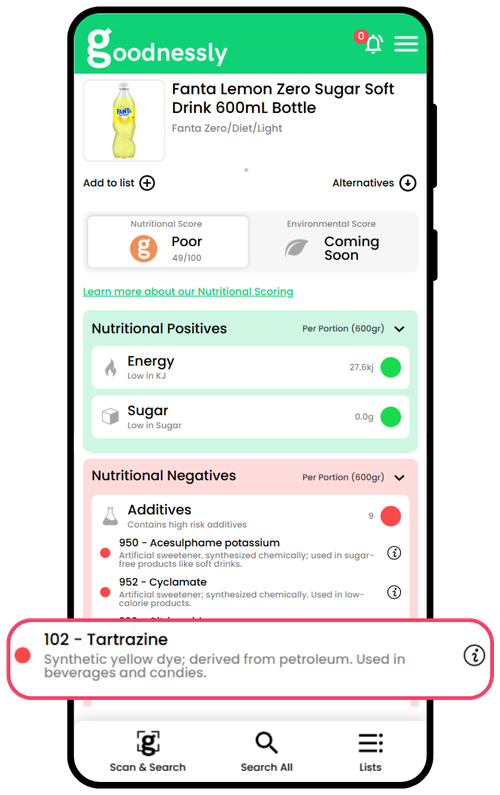
What are flavours?
Flavourings are substances used to add or change taste and smell. They can be extracted from plants or animals, made by fermentation or heating, or made synthetically, and one “flavour” on a label can be a blend of many substances in a carrier such as ethanol, glycerol or triethyl citrate. In Australia and New Zealand a flavouring must be a “permitted flavouring substance”, which the Code defines by reference to recognised lists (the US FEMA GRAS lists, the Council of Europe list, the EU Union list and 21 CFR 172.515) and to flavourings obtained from plant or animal material.
What's it used for?
- Giving a consistent taste from batch to batch
- Replacing flavour lost during processing
- Creating tastes like strawberry or barbecue without the whole ingredient
- Masking bitter or off notes, such as in protein powders
Where you'll find flavour on the shelf
It is one of the most common words on ingredient lists.
Is flavour safe? What the research says
Flavourings are assessed substance by substance. JECFA evaluates flavouring agents using a procedure that weighs chemical structure, metabolism and estimated intake, and the EU only allows flavouring substances on its Union list. Because flavours are used in very small amounts, regulators have generally found no safety concern at expected intakes. The trade-off for shoppers is transparency: one word on the label can stand for many substances.
| Region | Status | What this means |
|---|---|---|
| AU/NZ Australia & New Zealand (FSANZ) | Permitted | Permitted flavouring substances may be used at GMP (Schedule 16), with separate rules for quinine and caffeine. Declared as “flavouring” or “flavour” (Standard 1.2.4). |
| EU European Union (EFSA) | Permitted | Regulated under Regulation (EC) No 1334/2008. Only flavouring substances on the Union list (Implementing Regulation (EU) No 872/2012) may be used. |
| US United States (FDA) | Permitted | Natural and artificial flavors are defined in 21 CFR 101.22. Synthetic flavouring substances are listed in 21 CFR 172.515 and 182.60. |
Flavourings as a group have no E-number or INS code. Allergens in a flavouring must still be declared.
- EU, July 2024: Implementing Regulation (EU) 2024/2067 removed ten smoke flavouring primary products from the Union list, after EFSA could not rule out genotoxicity concerns for several of them. Foods using them had until 1 July 2026, or 1 July 2029 for some smoked meat, fish and cheese products.
- FDA, October 2018: Removed seven synthetic flavouring substances, including benzophenone, pulegone and styrene, from 21 CFR 172.515 under the Delaney Clause, as high-dose animal studies were associated with cancer. FDA said they did not pose a risk to public health at the levels used in food.
This section is checked periodically rather than continuously — if you're reading this well after the date above, it's worth confirming nothing has changed before citing it.
Who might want to limit or avoid it
- People with food allergies, who may want to check with the manufacturer (allergens must still be declared)
- People avoiding added glutamates, although these must be named on Australian and New Zealand labels
- Anyone who prefers to know exactly what’s in their food
Goodnessly rates flavours Moderate Risk. Individual flavouring substances are assessed and permitted, but the single word on the label doesn’t tell you which ones are inside, so we flag it for a closer look.
How to spot it on a label
Look out for:
- Flavour or flavouring
- Flavours (for example, “strawberry flavour”)
- Artificial flavour or nature-identical flavour
- Flavour (contains milk) or similar allergen notes
Always check the ingredient list, as the same ingredient can be listed under different names.
Related additives
Frequently asked questions
Why don’t labels list what’s in a flavour?
The Food Standards Code allows a flavouring to be listed as ‘flavouring’ or ‘flavour’, or by a more specific name. Its own ingredients don’t need to be listed, except added glutamates and ribonucleotides, which must be named, and caffeine, which must be listed as caffeine.
Are flavours allowed in Australia, the EU and the US?
Yes. Permitted flavouring substances are allowed in Australia and New Zealand, flavourings on the Union list are allowed in the EU under Regulation (EC) No 1334/2008, and the FDA regulates natural and artificial flavors under 21 CFR 101.22.
Do flavours have to declare allergens?
Yes. In Australia and New Zealand, allergens such as milk, soy, wheat or peanut must be declared even when they are part of a flavouring.
How does Goodnessly rate flavours?
Goodnessly rates flavours as Moderate Risk. Individual flavouring substances are assessed and permitted, but a single word on the label doesn’t tell you which ones are inside.
Don't decode labels by hand
Scan any product with the Goodnessly app to instantly see its full additive breakdown, kept current as new research like this comes to light.
Download our app to check additives in everyday foods