
What is vanillin?
Also labelled: Vanillin · 4-hydroxy-3-methoxybenzaldehyde · Vanilla flavour · Flavouring (vanillin) · FL 05.018
The main flavour compound in vanilla, usually made synthetically or by fermentation.
Vanillin is the compound that gives vanilla its familiar taste and smell. It occurs naturally in vanilla beans, but most vanillin in food is made from other starting materials or by fermentation. It is a permitted flavouring in Australia and New Zealand, the EU and the US, and JECFA has set an ADI of 0 to 10 mg/kg body weight. Goodnessly rates it Limited Risk.
Vanillin is a permitted flavouring substance in Australia and New Zealand, is on the EU Union list (FL 05.018), and is GRAS in the US (21 CFR 182.60). JECFA set an ADI of 0–10 mg/kg body weight per day and, in its latest evaluation in 2001, found no safety concern at current intakes as a flavouring agent.
Download our app to check additives in everyday foods
Read the FAQ →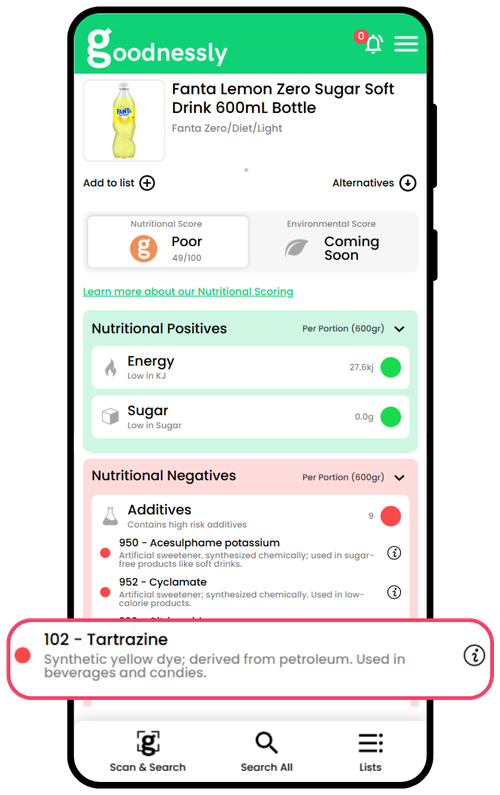
What is vanillin?
Chemically, vanillin is 4-hydroxy-3-methoxybenzaldehyde. Real vanilla extract contains vanillin along with many other aroma compounds, which is why it tastes rounder. Vanillin on its own gives a stronger, simpler vanilla note and costs far less, so it is common in mass-produced sweet foods. A related compound, ethyl vanillin, is stronger again.
What's it used for?
- Vanilla taste in sweet foods
- Rounding out chocolate and caramel flavours
- Masking bitterness in protein and nutrition drinks
- Boosting the sense of sweetness
Where you'll find vanillin on the shelf
Look for it in sweet and dessert-style foods.
Is vanillin safe? What the research says
Vanillin is one of the most widely used flavourings in the world and has a long history of evaluation. JECFA’s ADI of 0–10 mg/kg body weight per day is well above typical intakes from food. The main thing to know as a shopper is that “vanilla flavour” on a label may mean vanillin rather than vanilla beans.
| Region | Status | What this means |
|---|---|---|
| AU/NZ Australia & New Zealand (FSANZ) | Permitted | A permitted flavouring substance under Standard 1.1.2, allowed at GMP. Usually declared as “flavouring”, “flavour” or “vanilla flavour”. |
| EU European Union (EFSA) | Permitted | On the Union list of flavouring substances (FL 05.018) under Regulation (EC) No 1334/2008 and Implementing Regulation (EU) No 872/2012. |
| US United States (FDA) | GRAS | Listed as a GRAS synthetic flavouring substance (21 CFR 182.60). Standards for vanilla extract and vanilla-vanillin extract are in 21 CFR Part 169. |
JECFA’s upper ADI of 10 mg/kg body weight is about 600 mg a day for a 60 kg adult.
- No recent changes: We found no new regulatory actions on vanillin in our November 2026 check.
This section is checked periodically rather than continuously — if you're reading this well after the date above, it's worth confirming nothing has changed before citing it.
Who might want to limit or avoid it
- People who want real vanilla, who can look for “vanilla extract” or “vanilla bean”
- People with a specific diagnosed sensitivity (talk to your doctor)
- Anyone cutting back on sweet, processed foods, where it is most common
Goodnessly rates vanillin Limited Risk. It is permitted with a generous ADI, but it is mostly found in sweet, processed foods and may be listed simply as “flavour”.
How to spot it on a label
Look out for:
- Vanillin
- Flavouring (vanillin)
- Vanilla flavour (may be vanillin)
- Artificial or imitation vanilla
Always check the ingredient list, as the same ingredient can be listed under different names.
Related additives
Frequently asked questions
Is vanillin the same as vanilla extract?
No. Vanillin is the main flavour compound in vanilla, but vanilla extract also contains many other aroma compounds from the bean. Most vanillin used in food is made from other starting materials or by fermentation.
Is vanillin allowed in Australia, the EU and the US?
Yes. It is a permitted flavouring substance in Australia and New Zealand, is on the EU Union list of flavouring substances, and is listed as GRAS by the FDA (21 CFR 182.60).
How much vanillin is safe?
JECFA has set an acceptable daily intake of 0 to 10 mg per kg of body weight per day, which is well above typical intakes from food.
How does Goodnessly rate vanillin?
Goodnessly rates vanillin as Limited Risk. It is permitted with a generous ADI, but it is mostly found in sweet, processed foods and may be listed simply as ‘flavour’.
Don't decode labels by hand
Scan any product with the Goodnessly app to instantly see its full additive breakdown, kept current as new research like this comes to light.
Download our app to check additives in everyday foods