
What is E100?
Curcumin or turmeric (E100) is a yellow food colour used in specified foods. Goodnessly rates E100 Safe, while food-category permissions and the EFSA ADI still apply.
Curcumin or turmeric is used in specified food applications. Check the food category, amount and full formulation rather than judging one ingredient in isolation.
Download our app to check additives in everyday foods · Eco score: Coming Soon
Read the FAQ →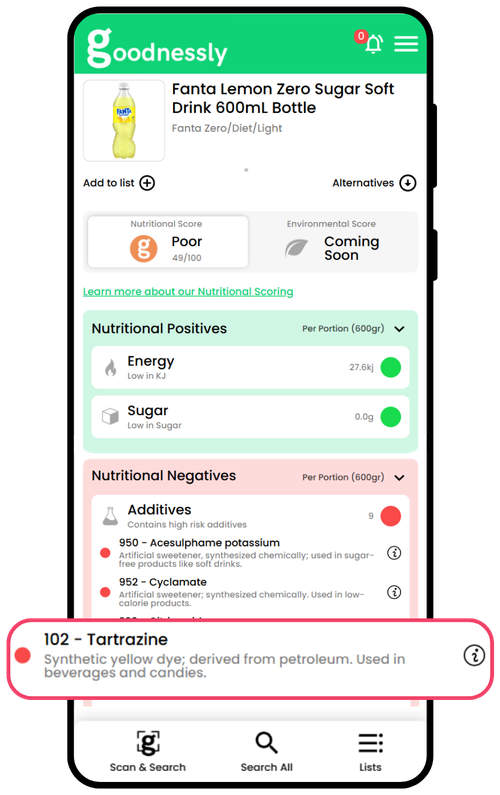
What is Curcumin or turmeric?
Curcumin is the principal yellow pigment associated with turmeric. As E100, it is used as a food colour in specified formulations.
What's it used for?
- Adding a yellow colour
- Supporting colour consistency
- Used in selected foods and preparations
- Providing a turmeric-derived colour option
Where you'll find E100 on the shelf
You may see it in foods where a yellow or turmeric-associated colour is wanted, including prepared foods, sauces and other colour-controlled formulations.
Is E100 permitted? What the regulators say
E100 is authorised or permitted in the three systems checked, with category and specification conditions applying.
| Region | Status | What this means |
|---|---|---|
| AU/NZ Australia & New Zealand (FSANZ) | Permitted with conditions | FSANZ Schedule 15 includes additive 100 curcumin/turmeric, subject to food-category permissions and levels. |
| EU European Union (EFSA) | Authorised with conditions | The EU Union list includes E100 curcumin for specified food categories and conditions. |
| US United States (FDA) | Permitted with conditions | FDA 21 CFR 73.600 and 73.615 permit turmeric and turmeric oleoresin as certification-exempt colour additives, subject to the listed conditions. |
Goodnessly rates E100 Safe within its rating system. The rating does not remove the need to consider the product category, amount or full formulation.
- EFSA’s re-evaluation of curcumin was completed in 2010 and established an ADI of 0–3 mg/kg body weight/day.
- EFSA’s 2014 exposure refinement followed the re-evaluation; at maximum use levels, estimates for some 1–10-year-old children were above the ADI in some countries.
- The ADI is a population risk-assessment reference, not a statement that a particular food is unsafe.
This section is checked periodically rather than continuously — if you're reading this well after the date above, it's worth confirming nothing has changed before citing it.
Who might want to limit or avoid it
- People comparing colours used across different products
- People who want to check the amount and frequency of coloured foods
- People considering turmeric-derived colour alongside the whole ingredient list
Goodnessly rates E100 Safe as a practical prompt to understand the ingredient, the product and the overall formulation.
How to spot it on a label
Look for:
- Curcumin
- Turmeric
- 100 or E100
- Colour (100)
Ingredient labels may use the name, the number, or the additive class followed by the number.
Related additives
Frequently asked questions
What is E100?
E100 is curcumin, the yellow pigment associated with turmeric, used as a food colour in specified applications.
Is E100 permitted?
E100 is permitted with conditions in Australia/New Zealand and the EU. In the US, turmeric and turmeric oleoresin are permitted certification-exempt colours under specific FDA rules.
Why is curcumin rated Safe?
Goodnessly rates E100 Safe within its rating system, while the permitted food category, amount and EFSA ADI still matter.
How does Goodnessly rate E100?
Goodnessly rates E100 (curcumin or turmeric) as Safe.
Don't decode labels by hand
Scan any product with the Goodnessly app to see its full additive breakdown and understand the label at a glance.
Download our app to check additives in everyday foods · Eco score: Coming Soon