
E120 colour: what is cochineal (carmine) in food?
Also labelled: Colour 120 · E120 colour · Cochineal · Cochineal extract · Carmine · Carmines · Carminic acid · Natural Red 4 · INS 120
E120 colour, also labelled colour 120, cochineal, carmine or carminic acid (INS 120), is a red to pink food colour made from dried cochineal insects. Goodnessly rates it Moderate Risk as a prompt to notice the colour’s insect origin and the labelling rules around it.
Cochineal comes from female Dactylopius coccus insects; carminic acid is the colour compound, and carmines are its aluminium lakes. It gives red and pink shades to foods such as some yoghurts, ice creams and lollies. EFSA’s 2015 re-evaluation kept the ADI at 2.5 mg carminic acid per kilogram of body weight per day (equivalent to 5 mg carmine) and noted that allergic reactions have been reported in some sensitive people.
Download our app to check additives in everyday foods
Read the FAQ →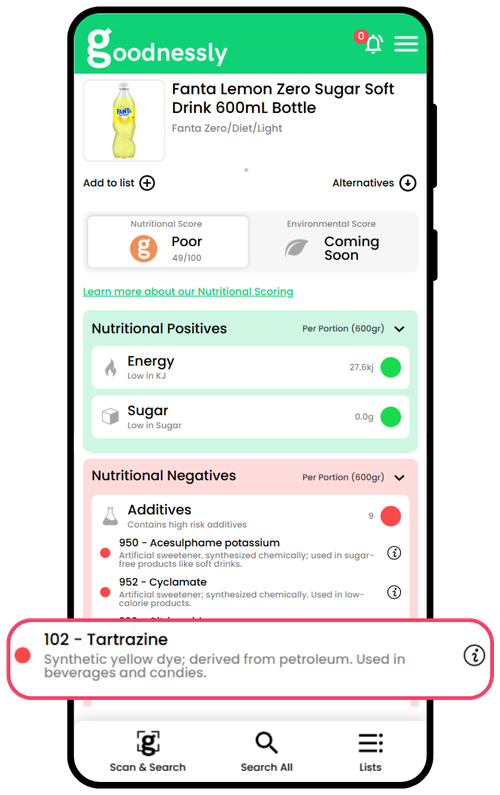
What is Cochineal or carmines or carminic acid?
E120 covers colour preparations derived from cochineal insects, including carmines and carminic acid. It gives a red to pink shade in selected foods.
What's it used for?
- Adding red or pink colour
- Supporting consistent appearance
- Colouring selected drinks, desserts and confectionery
Where you'll find E120 on the shelf
It is most relevant to red or pink drinks, confectionery, desserts, fruit preparations and other coloured foods.
Products containing E120 (INS 120)
Examples from products we've rated where E120 appears in the listed ingredients. Formulations change, so always check the current pack.
Is E120 safe? What the regulators say
E120 is authorised with conditions in all three regions checked, but the source and required declaration can matter to dietary, cultural or allergy-related choices.
| Region | Status | What this means |
|---|---|---|
| AU/NZ Australia & New Zealand (FSANZ) | Permitted with conditions | FSANZ lists cochineal, carmines and carminic acid as additive 120; category conditions and the required name apply. |
| EU European Union (EFSA) | Authorised with conditions | E120 is on the EU Union list for specified food categories. The applicable colour name and any required labelling statement must be followed. |
| US United States (FDA) | Exempt colour additive with declaration requirements | FDA lists cochineal extract and carmine as colour additives exempt from certification, with specific declaration requirements under 21 CFR 73.100. |
Moderate Risk is about source transparency and personal choice. It is not a claim that E120 is unsafe for everyone.
- FSANZ Food Standards Code, Schedule 15, additive 120.
- EUR-Lex Regulation (EC) No 1333/2008 Union list, E120.
- FDA 21 CFR 73.100, Cochineal extract and carmine.
This section is checked periodically rather than continuously — if you're reading this well after the date above, it's worth confirming nothing has changed before citing it.
Who might want to limit or avoid it
- People avoiding insect-derived ingredients
- People checking colour source for cultural or dietary reasons
- People who need to read colour declarations carefully
Goodnessly rates E120 Moderate Risk because the source may matter even when the colour is permitted.
How to spot it on a label
Look for:
- Cochineal
- Carmine
- Carminic acid
- 120 or E120
- Colour (120)
Check the full ingredient name as well as the number; labels may use cochineal, carmine or carminic acid.
Related additives
Frequently asked questions
What is E120 in food?
E120 is a red colour made from cochineal insects. The label may say colour (120), cochineal, carmine or carminic acid. It gives a red or pink shade to foods such as some yoghurts, ice creams, lollies, fillings and drinks.
Is E120 vegetarian or vegan?
No. E120 is derived from insects, so it is not suitable for vegans, and many vegetarians also choose to avoid it. If that matters to you, check the ingredient list for colour 120, cochineal or carmine.
Is E120 linked to allergic reactions?
Allergic reactions to carmine have been reported in some sensitive people. EFSA's 2015 re-evaluation noted these reports and recommended purification steps to reduce the residual insect proteins associated with them. It did not find a reason to change the ADI of 2.5 mg carminic acid per kilogram of body weight per day.
How does Goodnessly rate E120?
Goodnessly rates E120 (cochineal, carmines or carminic acid) as Moderate Risk. It is permitted with conditions in Australia/New Zealand, the EU and the US. Moderate Risk is a prompt to notice its insect origin and the allergy reports, not a statement that permitted use is harmful.
Don't decode labels by hand
Scan any product with the Goodnessly app to instantly see its full additive breakdown, kept current as new research like this comes to light.
Download our app to check additives in everyday foods
At Goodnessly we aim to educate and empower individuals to make informed choices about everyday products.
© 2024 . All rights reserved.
Facebook
Instagram
X
TikTok