Additive 143: what is fast green FCF?
Also labelled: Fast green FCF · FD&C Green No. 3 · Green 3 · Colour 143 · INS 143
A synthetic sea-green food colour, known in the US as FD&C Green No. 3.
Fast green FCF (143) is a synthetic triarylmethane colour that gives a turquoise green shade. It is permitted in Australia and New Zealand and in the US as FD&C Green No. 3, but it is not authorised in the EU. Goodnessly rates it Hazardous Risk.
Permitted in Australia and New Zealand (FSANZ) but not approved in the EU. Note that it is permitted in the US as FD&C Green No. 3 (21 CFR 74.203).
Download our app to check additives in everyday foods
Read the FAQ →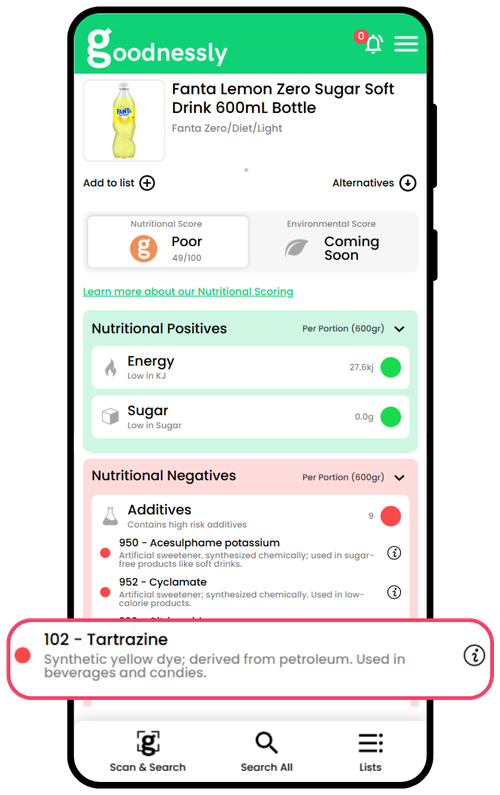
What is fast green FCF?
Fast green FCF is a synthetic dye made from petroleum-derived chemicals. It is often blended with yellow colours to make green shades.
What's it used for?
- Colouring confectionery
- Green drinks and cordials
- Icings and decorations
- Desserts
Where you'll find fast green FCF on the shelf
It is most likely found in brightly coloured sweets and drinks.
Is fast green FCF safe? What the research says
JECFA confirmed an ADI of 0 to 25 mg/kg body weight for fast green FCF in 2017. It is not on the EU list of authorised colours.
| Region | Status | What this means |
|---|---|---|
| AU/NZ Australia & New Zealand (FSANZ) | Permitted | Permitted as a colour to a maximum level in specified foods under Schedule 15. |
| EU European Union (EFSA) | Not authorised | Not included in the Union list of food colours. |
| US United States (FDA) | Permitted | Listed as FD&C Green No. 3 under 21 CFR 74.203. It requires batch certification. |
In April 2025 US health authorities announced plans to phase out petroleum-based synthetic dyes. That plan is voluntary and still in progress.
- JECFA 2017: JECFA kept the ADI of 0 to 25 mg/kg body weight.
- US 2025: HHS and FDA announced plans to phase out petroleum-based synthetic dyes from food.
This section is checked periodically rather than continuously — if you're reading this well after the date above, it's worth confirming nothing has changed before citing it.
Who might want to limit or avoid it
- Parents limiting synthetic colours for children
- Anyone avoiding petroleum-derived dyes
- Shoppers comparing local and EU products
Goodnessly rates 143 Hazardous Risk. It is a synthetic dye that the EU does not authorise.
How to spot it on a label
Look out for:
- Fast green FCF
- Colour (143)
- FD&C Green No. 3 or Green 3 on US imports
Always check the ingredient list, as the same ingredient can be listed under different names.
Related additives
Frequently asked questions
Is fast green FCF the same as Green 3?
Yes. In the US it is called FD&C Green No. 3.
Is 143 banned in the EU?
It is not authorised as a food colour in the EU. It is permitted in Australia, New Zealand and the US.
Is fast green FCF the same as Green S?
No. Green S (142) is a different synthetic green colour.
How does Goodnessly rate 143?
Goodnessly rates 143 (Fast green FCF) as Hazardous Risk. It is a synthetic dye that the EU does not authorise.
Don't decode labels by hand
Scan any product with the Goodnessly app to instantly see its full additive breakdown, kept current as new research like this comes to light.
Download our app to check additives in everyday foods