What is 312?
A synthetic antioxidant used to stop oils and fats from going rancid.
Dodecyl gallate (312) is a synthetic antioxidant, an ester of gallic acid, used to protect fats and oils from oxidation. It is still permitted in Australia and New Zealand, but the EU removed it from its list of approved additives in 2018, and it has no US food additive or GRAS listing. Goodnessly rates it Hazardous Risk.
Permitted in Australia and New Zealand (FSANZ) but not approved in the EU or the US. The EU removed dodecyl gallate in 2018 under Regulation (EU) 2018/1481, and we found no FDA food additive or GRAS listing.
Download our app to check additives in everyday foods
Read the FAQ →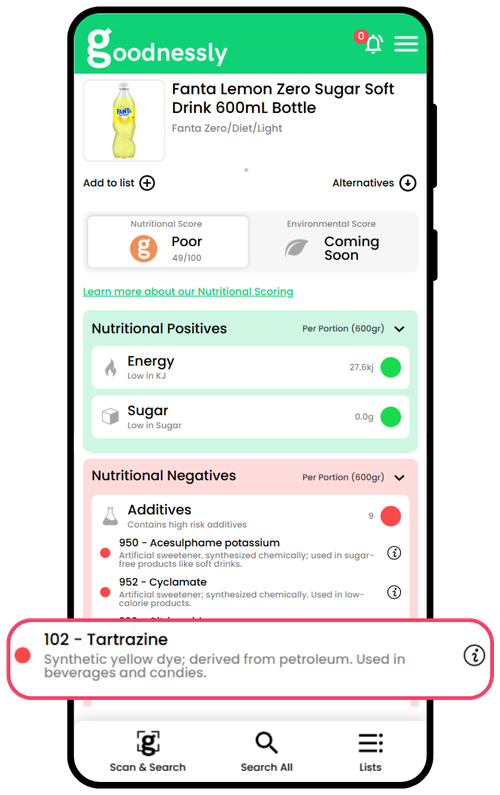
What is dodecyl gallate?
Dodecyl gallate is made by joining gallic acid with dodecyl (lauryl) alcohol. It belongs to the same family as propyl gallate (310) and octyl gallate (311). It dissolves in fats, which makes it useful in oils and fatty foods.
What's it used for?
- Antioxidant in edible oils and fats
- Protecting fat-based spreads
- Slowing rancidity in some processed foods
- Stabilising flavourings
Where you'll find 312 on the shelf
It is rarely used today. When it is used, it is mainly in oils and fats.
Is dodecyl gallate safe? What the research says
EFSA re-evaluated dodecyl gallate in 2015 and found the toxicology data too limited to set an ADI or confirm its safety. EFSA could not reach a definitive conclusion on carcinogenic potential, although it noted no genotoxicity concern. When no business provided the requested data, the EU removed it from the Union list.
| Region | Status | What this means |
|---|---|---|
| AU/NZ Australia & New Zealand (FSANZ) | Permitted | Listed in the Food Standards Code and permitted as an antioxidant in specified foods such as edible oils (up to 100 mg/kg). |
| EU European Union (EFSA) | Not authorised | Removed from the Union list by Regulation (EU) 2018/1481 after EFSA (2015) could not confirm its safety. |
| US United States (FDA) | Not permitted | No 21 CFR food additive or GRAS listing. It appears in the FDA ingredient inventory with no regulation cited. |
EFSA concluded that the old group ADI for propyl, octyl and dodecyl gallate was no longer valid.
- EU removal, 2018: Regulation (EU) 2018/1481 deleted E311 and E312 because no toxicological data were supplied after a 2017 call for data.
- EFSA, May 2015: EFSA could not establish an ADI for dodecyl gallate.
This section is checked periodically rather than continuously — if you're reading this well after the date above, it's worth confirming nothing has changed before citing it.
Who might want to limit or avoid it
- Anyone who prefers additives with a complete, up-to-date safety assessment
- People with sensitive skin, because gallates are associated with contact allergy in some reports (talk to your doctor)
- Shoppers comparing local and imported products
Goodnessly rates 312 Hazardous Risk. The EU withdrew it after EFSA could not confirm its safety, and it has no US approval.
How to spot it on a label
Look out for:
- Dodecyl gallate or lauryl gallate
- Antioxidant (312)
- E312 on older imported labels
Always check the ingredient list, as the same additive can be listed by name or by number.
Related additives
Frequently asked questions
Why was dodecyl gallate removed in the EU?
EFSA found too few toxicology data to confirm its safety. No company supplied the missing data, so the EU deleted it from the approved list in 2018.
Is 312 banned in the US?
It has no FDA food additive or GRAS listing, so it is not an approved food additive there. It is still permitted in Australia and New Zealand.
Is dodecyl gallate the same as propyl gallate?
No. They are related gallic acid esters, but propyl gallate (310) is still authorised in the EU, while dodecyl gallate is not.
How does Goodnessly rate 312?
Goodnessly rates 312 (Dodecyl gallate) as Hazardous Risk. The EU withdrew it after EFSA could not confirm its safety, and it has no US approval.
Don't decode labels by hand
Scan any product with the Goodnessly app to instantly see its full additive breakdown, kept current as new research like this comes to light.
Download our app to check additives in everyday foods