
What is E414?
Acacia gum, also called gum arabic — a natural tree sap that's been used in food for centuries, now getting a second look because of newer research on emulsifiers generally.
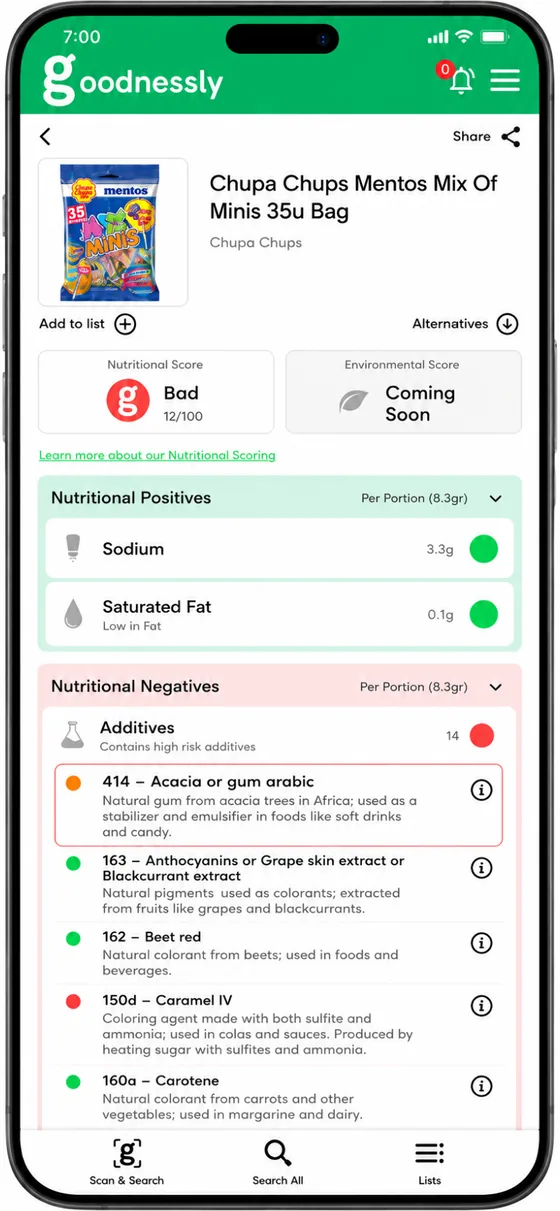
E414 is acacia gum (also called gum arabic), a natural gum tapped from acacia trees and used as a thickener, stabiliser and emulsifier. Food safety regulators consider it one of the lowest-concern additives in use, with no formal daily intake limit set anywhere. Goodnessly rates it Caution because a large 2024 French cohort study found a small statistical association between higher intake and type 2 diabetes risk — the same research that led the competing app Yuka to downgrade its own rating too.
Download our app to check additives in everyday foods
Read the FAQ →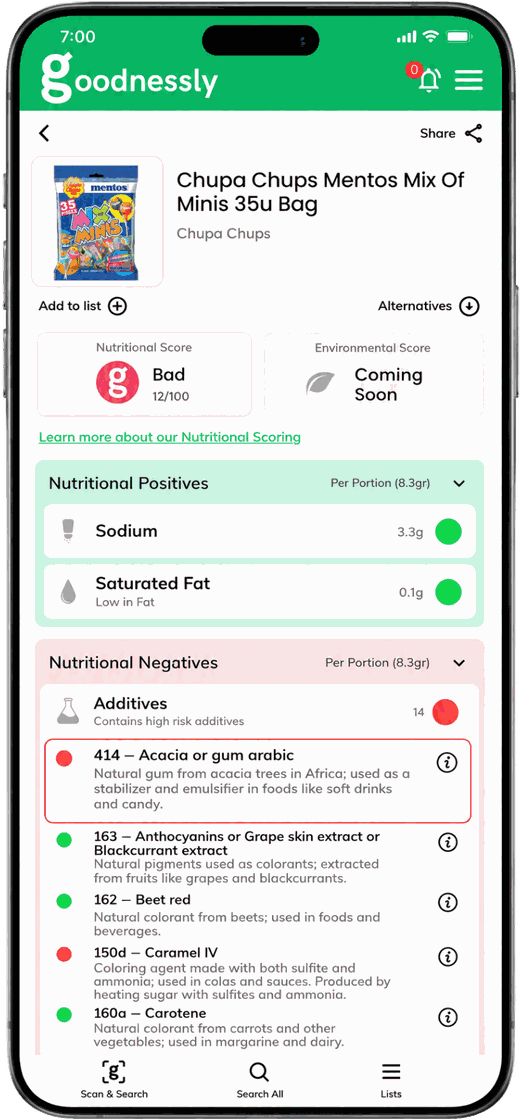
What is acacia gum?
Acacia gum is a natural gum harvested from the sap of acacia trees, mainly grown across the Sahel region of Africa — Sudan, Chad and Nigeria supply most of the world's commercial gum arabic. Small cuts are made in the bark, and the sap that seeps out hardens into "tears" that are collected, cleaned and processed into a powder. It's one of the oldest food additives in continuous use, valued for its ability to bind and stabilise mixtures without adding much flavour of its own.
What's it used for?
- Keeping flavour oils evenly mixed through soft drinks and juice drinks
- Smoothing and stabilising coatings on lollies and confectionery
- Adding body as a thickener and stabiliser in a wide range of processed foods
- Encapsulating delicate flavour compounds so they survive processing
- Contributing soluble fibre in some fibre-enriched products
Where you'll find 414 on the shelf
Acacia gum turns up wherever a product needs to hold a mixture together without separating.
Is acacia gum safe? What the research says
Acacia gum has one of the cleanest regulatory records of any food additive — but a large 2024 cohort study has added a genuine new wrinkle to that picture. Here's how regulators currently treat it:
| Region | Status | What this means |
|---|---|---|
| AU/NZ Australia & New Zealand (FSANZ) | Permitted, no limit | Permitted at quantum satis (as much as needed for the intended purpose), with no maximum level set. |
| EU European Union (EFSA) | Permitted, no ADI | Listed as E414. EFSA re-evaluated it in 2017 and concluded no numerical Acceptable Daily Intake was necessary — the designation used for additives of very low toxicological concern. |
| US United States (FDA) | GRAS | Holds Generally Recognized As Safe status under 21 CFR 172.780. |
JECFA (the joint WHO/FAO expert committee) reached the same conclusion as EFSA: an ADI "not specified." The main documented downside at high intakes is mild bloating or digestive discomfort, since acacia gum is a fermentable fibre that reaches the colon largely intact.
- 2024 NutriNet-Santé emulsifier study: a large French cohort study published in The Lancet Diabetes & Endocrinology (Salame et al., 2024), following 104,139 adults over an average of 6.8 years, found a small but statistically significant association between higher acacia gum intake and type 2 diabetes risk (3% higher risk per 1000mg/day increment). Several other texture agents showed similar associations, including guar gum and xanthan gum. This is an observational study, which can show an association but can't on its own prove the additive causes the increased risk.
- Yuka downgraded its rating in March 2024: the popular French scanning app moved acacia gum from Green to Yellow in direct response to this research, alongside guar gum, xanthan gum, pectin and several related texture agents. No regulator has changed acacia gum's legal status as a result.
This section is checked periodically rather than continuously — if you're reading this well after the date above, it's worth confirming nothing has changed before citing it.
Who this matters to
- Anyone who regularly consumes products high in acacia gum, such as fibre-fortified drinks or bars, and wants to factor in the newer diabetes-risk research alongside its long safety record
- People who are already monitoring type 2 diabetes risk through diet more broadly
- Anyone sensitive to fermentable fibres, who may notice bloating at higher intakes regardless of the additive debate
Goodnessly rates E414 Caution to reflect this genuine, if still-developing, area of research — not because regulators or long-term safety data suggest a problem with typical use. It remains one of the most extensively reviewed and lowest-toxicity additives in the food supply.
How to spot it on a label
Acacia gum is typically declared clearly on Australian ingredient lists. Look out for:
- Acacia gum
- Gum arabic
- 414 or E414
- "Stabiliser (414)" or "Thickener (414)" in the ingredients list
Soft drinks, confectionery and fibre-enriched products are the most common places to find it.
Related additives
Frequently asked questions
Is E414 the same as gum arabic?
Yes — 414 (or E414) is the additive code for acacia gum, also known as gum arabic. Both names refer to the same natural gum tapped from acacia trees.
Is acacia gum natural?
Yes. Unlike many food additives, acacia gum isn't synthesised in a lab — it's harvested directly from the sap of acacia trees, then cleaned and processed into a powder. No chemical modification is involved.
Does acacia gum cause diabetes?
A large 2024 French cohort study found a small statistical association between higher acacia gum intake and type 2 diabetes risk, but this kind of observational study can show a link without proving the additive causes it. No food safety regulator has changed acacia gum's approval status in response, though the popular scanning app Yuka did downgrade its own rating for it around the same time.
Does Goodnessly rate E414 as safe, caution, or avoid?
Goodnessly rates E414 (Acacia / Gum Arabic) as Caution. It has an excellent long-term safety record with food regulators worldwide, but newer research linking higher intakes to type 2 diabetes risk means it no longer sits in our Safe tier while that evidence is still developing.
Is acacia gum vegan and gluten-free?
Yes to both. It's a plant-derived tree sap, contains no animal products, and is naturally gluten-free.
Don't decode labels by hand
Scan any product with the Goodnessly app to instantly see its full additive breakdown, kept current as new research like this comes to light.
Download our app to check additives in everyday foods
At Goodnessly we aim to educate and empower individuals to make informed choices about everyday products.
© 2026 Goodnessly. All rights reserved.
Facebook
Instagram
X
TikTok