
What is E433?
Polysorbate 80 (polyoxyethylene (20) sorbitan monooleate) — one of the most widely used synthetic polysorbate emulsifiers in ice cream and processed foods.
Polysorbate 80 (E433), also labelled polyoxyethylene (20) sorbitan monooleate, is a non-ionic emulsifier widely used in ice cream, whipped toppings, shortenings, vitamin drops and other processed foods. It is the polysorbate most often discussed in consumer media. EFSA's 2015 re-evaluation set a group ADI of 25 mg/kg body weight per day for E432–E436 and noted toddler high-level exposure can sit close to that ADI. It is permitted in Australia/NZ and authorised in the EU for specified categories. In the US it is a direct food additive under 21 CFR 172.840 with food-specific limits. Goodnessly rates it Avoid.
Download our app to check additives in everyday foods
Read the FAQ →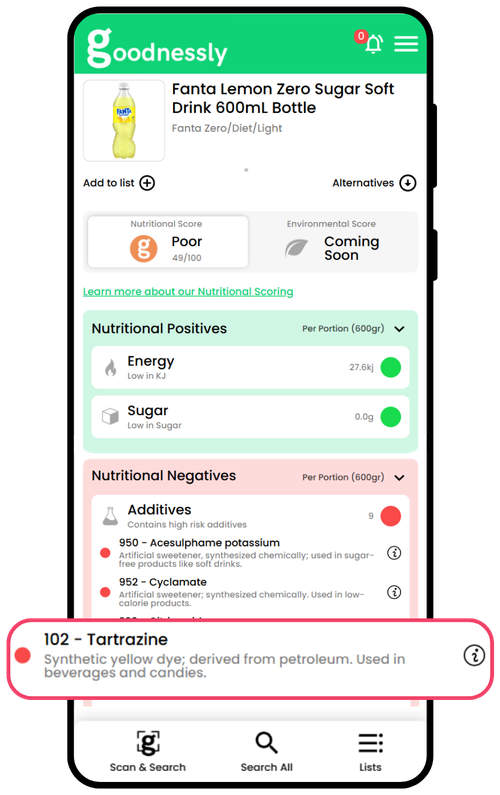
What is polysorbate 80?
Polysorbate 80 is a polyoxyethylene sorbitan ester of oleic acid (monooleate). The "80" is the traditional trade number for that ethoxylated monooleate. EFSA assesses it with the other food polysorbates under one group ADI; the key long-term study underpinning the 2015 ADI used polysorbate 80. On labels you may see "polysorbate 80", "polyoxyethylene (20) sorbitan monooleate", "433", "E433", or "emulsifier (433)".
What's it used for?
- Emulsifier in ice cream, frozen custard, sherbet and related frozen desserts
- Whipped edible-oil toppings and shortening / edible-oil emulsifier systems
- Solubilising fat-soluble vitamins and flavours in some special dietary foods (US has a daily milligram direction limit for some uses)
- Other processed foods where a strong synthetic emulsifier is needed
Where you'll find E433 on the shelf
Very common in industrial ice cream and emulsified processed foods; also appears in some vitamin and flavour systems.
Is polysorbate 80 safe? What the research says
EFSA's 2015 opinion is the main EU food-additive re-evaluation for polysorbate 80. It concluded the toxicology database supports a group ADI of 25 mg/kg bw/day and that refined high toddler exposure can approach that ADI. Separate research and media discussion sometimes focuses on gut-barrier or microbiome associations for emulsifiers in general; those findings are not the same as a regulatory ban, and wording on this page stays with regulator ADI/exposure language rather than disease claims. Goodnessly's Avoid rating reflects a preference to skip routine ethoxylated emulsifiers.
| Region | Status | What this means |
|---|---|---|
| AU/NZ Australia & New Zealand (FSANZ) | Permitted (polysorbates; often GMP) | Listed as polysorbate 80 / polyoxyethylene (20) sorbitan monooleate (433) in Schedule 8 / Schedule 15. Among the longer-permitted polysorbates in AU/NZ (with 435 and 436) for emulsifier uses under the Food Standards Code. Must be declared by name or number when used as a food additive. |
| EU European Union (EFSA) | Authorised; group ADI 25 mg/kg bw/day (EFSA 2015) | Authorised as E433 under Regulation (EC) No 1333/2008 for specified categories with maximum levels. EFSA ANS Panel (2015) used a polysorbate 80 long-term rat study (NOAEL 2,500 mg/kg bw/day) as a key study when setting the group ADI of 25 mg/kg bw/day for E432–E436. |
| US United States (FDA) | Direct food additive (21 CFR 172.840) | Polysorbate 80 may be used under 21 CFR 172.840 as an emulsifier in listed foods with product-specific limits (examples include frozen desserts; whipped edible oil toppings; shortenings and edible oils; and special dietary foods as an emulsifier for edible fats/oils with directions limiting ingestion to not more than 360 mg polysorbate 80 per day for that use). Federal authorisation remains in force as of this draft (September 2026). |
Consumer articles sometimes link "polysorbate 80" to gut or immune findings from experimental models. Those associations are not presented here as proof that supermarket ice cream is harmful in ordinary labelled servings. Our Avoid rating is a precautionary household choice against ethoxylated emulsifiers, aligned with the wider E432–E436 set.
- EFSA 2015 (E432–E436): group ADI 25 mg/kg bw/day; polysorbate 80 study central to the NOAEL; toddler high exposure near the ADI.
- FDA 21 CFR 172.840: continues to list polysorbate 80 for specified direct food emulsifier uses and limits.
- EU 2020/356: limited extra polysorbate permissions in some drink categories; ADI impact judged negligible.
This section is checked periodically rather than continuously — if you're reading this well after the date above, it's worth confirming nothing has changed before citing it.
Who might want to limit or avoid it
- People avoiding polysorbate 80 / synthetic emulsifiers in ice cream and processed foods
- Shoppers reducing ultra-processed desserts and emulsified ready foods
- Anyone applying a single Avoid rule to the whole 432–436 family
Goodnessly rates E433 Avoid. Polysorbate 80 remains widely permitted, but EFSA's group ADI exposure picture and our preference against ethoxylated emulsifiers keep it out of Clear.
How to spot it on a label
Check ice cream and processed-food labels for:
- Polysorbate 80
- Polyoxyethylene (20) sorbitan monooleate
- 433 or E433
- Emulsifier (433)
- Other polysorbates: 432, 435, 436
One of the most common polysorbate declarations on Australian and US packs.
Related additives
Frequently asked questions
What is Polysorbate 80 (E433) made from?
It is a synthetic emulsifier made by ethoxylating a sorbitan ester of oleic acid. It is manufactured for technological use, not a whole food.
Is polysorbate 80 banned anywhere for food?
It remains authorised in the EU, permitted in Australia/NZ, and listed by FDA under 21 CFR 172.840 for specified food uses. Goodnessly's Avoid rating is stricter than a ban.
Why do people worry about polysorbate 80?
Besides being a synthetic ethoxylated emulsifier, it is the best-known polysorbate in ice cream. EFSA still sets a group ADI rather than a ban; experimental gut-emulsifier research is not treated here as a clinical diagnosis.
Does Goodnessly rate E433 as safe, caution or avoid?
Goodnessly rates E433 (Polysorbate 80) as Avoid.
Don't decode labels by hand
Scan any product with the Goodnessly app to instantly see its full additive breakdown, kept current as new research like this comes to light.
Download our app to check additives in everyday foods
At Goodnessly we aim to educate and empower individuals to make informed choices about everyday products.
© 2024 . All rights reserved.
Facebook
Instagram
X
TikTok