
What is natural flavour?
Also labelled: Natural flavour · Natural flavouring · Natural flavours · Natural [fruit] flavour
Flavouring made from plant, animal or microbial sources rather than synthesised.
Natural flavour is flavouring taken from a natural source such as fruit, spices, vanilla, meat or yeast, or made from natural materials by processes like fermentation. “Natural” doesn’t always mean it comes from the food pictured on the pack, and a natural flavour can still be a blend of many substances. It is permitted in Australia and New Zealand, the EU and the US. Goodnessly rates it Moderate Risk.
The Food Standards Code doesn’t define “natural flavour”, so in Australia and New Zealand the word “natural” falls under general rules against misleading labels. The EU (Regulation (EC) No 1334/2008, Article 16) and the US (21 CFR 101.22) set specific rules for using it.
Download our app to check additives in everyday foods
Read the FAQ →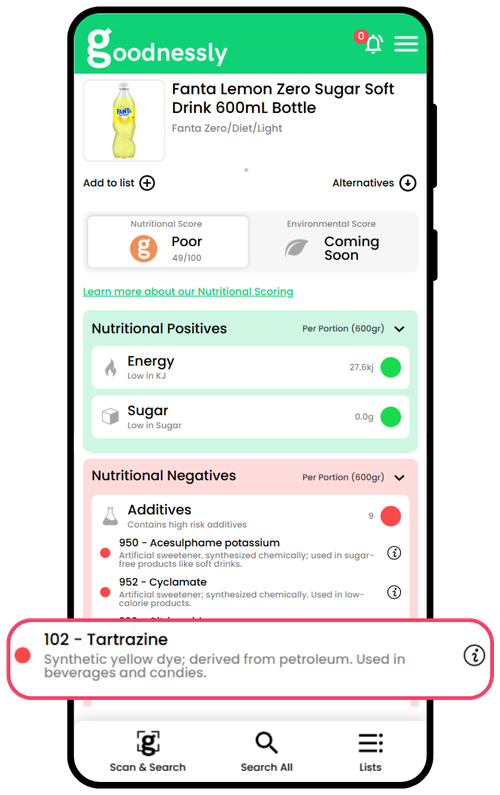
What is natural flavour?
A natural flavouring is made from material of plant, animal or microbial origin using processes such as extraction, distillation, roasting, enzymes or fermentation. Natural flavours are often concentrated and blended, so a “natural strawberry flavour” may contain flavour substances from more than one source. In the EU, “natural [X] flavouring” can only be used if at least 95% of the flavouring component comes from X.
What's it used for?
- Strengthening the taste of fruit, dairy or savoury foods
- Replacing flavour lost in heating and processing
- Keeping taste consistent between batches
- Supporting “no artificial flavours” claims
Where you'll find natural flavour on the shelf
Look for it on foods that promote natural or “no artificial” ingredients.
Is natural flavour safe? What the research says
Natural flavouring substances are assessed in the same way as other flavourings, and many are the same molecules found in everyday foods. “Natural” describes where a flavour comes from, not whether it is safer than an equivalent synthetic version, and regulators evaluate both on the same basis. They are used in very small amounts.
| Region | Status | What this means |
|---|---|---|
| AU/NZ Australia & New Zealand (FSANZ) | Permitted | Permitted flavouring substances include those obtained from plant or animal material by physical, microbiological, enzymatic or chemical processes. The Code has no specific definition of “natural flavour”. |
| EU European Union (EFSA) | Permitted | Article 16 of Regulation (EC) No 1334/2008 limits “natural” to flavourings made only from flavouring preparations and/or natural flavouring substances. “Natural X flavouring” needs at least 95% from X. |
| US United States (FDA) | Permitted | 21 CFR 101.22(a)(3) defines natural flavor as essential oils, extracts and similar products from spices, fruit, vegetables, meat, seafood, dairy and other natural sources, used mainly for flavour rather than nutrition. |
Natural flavours have no E-number or INS code. Allergens in a flavouring must still be declared.
- No recent changes: We found no new regulatory actions on natural flavour labelling in our November 2026 check.
This section is checked periodically rather than continuously — if you're reading this well after the date above, it's worth confirming nothing has changed before citing it.
Who might want to limit or avoid it
- People with food allergies (allergens must still be declared, but you can ask the manufacturer for more detail)
- Vegetarians and vegans, as natural flavours can come from animal sources
- People avoiding added glutamates, which must be named on Australian and New Zealand labels
Goodnessly rates natural flavour Moderate Risk. It is permitted everywhere and used in tiny amounts, but the label doesn’t say what it’s made from or what it contains.
How to spot it on a label
Look out for:
- Natural flavour or natural flavouring
- Natural [strawberry] flavour
- Natural flavours
- Natural flavour (contains milk) or similar allergen notes
Always check the ingredient list, as the same ingredient can be listed under different names.
Related additives
Frequently asked questions
Is natural flavour healthier than artificial flavour?
Not necessarily. ‘Natural’ describes the source of a flavour, not its safety, and regulators assess natural and synthetic flavouring substances on the same basis.
Is natural flavour vegan?
Not always. Natural flavours can be made from animal sources such as meat, dairy or seafood. Allergens like milk must be declared, but if you avoid animal products, check with the manufacturer.
Does natural strawberry flavour come from strawberries?
Not always. In the EU, ‘natural strawberry flavouring’ must be at least 95% from strawberries. Australia and New Zealand don’t have a specific rule, so the claim simply must not be misleading.
How does Goodnessly rate natural flavour?
Goodnessly rates natural flavour as Moderate Risk. It is permitted and used in small amounts, but the label doesn’t tell you what it’s made from or what it contains.
Don't decode labels by hand
Scan any product with the Goodnessly app to instantly see its full additive breakdown, kept current as new research like this comes to light.
Download our app to check additives in everyday foods