
What is yeast extract?
Also labelled: Yeast extract · Autolysed yeast extract · Autolysed yeast · Hydrolysed yeast · Yeast extract powder
A savoury flavouring made from the contents of yeast cells, rich in free glutamate.
Yeast extract is made by breaking down yeast cells, usually letting the yeast’s own enzymes digest it (autolysis), then removing the cell walls. What’s left is a savoury, salty, umami paste or powder, the same kind of product as yeast spreads. It is sold as a food ingredient in Australia and New Zealand, the EU and the US. Goodnessly rates it Hazardous Risk, mainly because it is a concentrated source of free glutamate that isn’t listed as MSG.
Yeast extract isn’t a numbered additive. In the US, bakers’ yeast extract is GRAS (21 CFR 184.1983), and FDA notes that free glutamate occurs naturally in ingredients such as yeast extract and autolysed yeast. FDA considers “No MSG” claims misleading on foods that contain sources of free glutamate.
Download our app to check additives in everyday foods
Read the FAQ →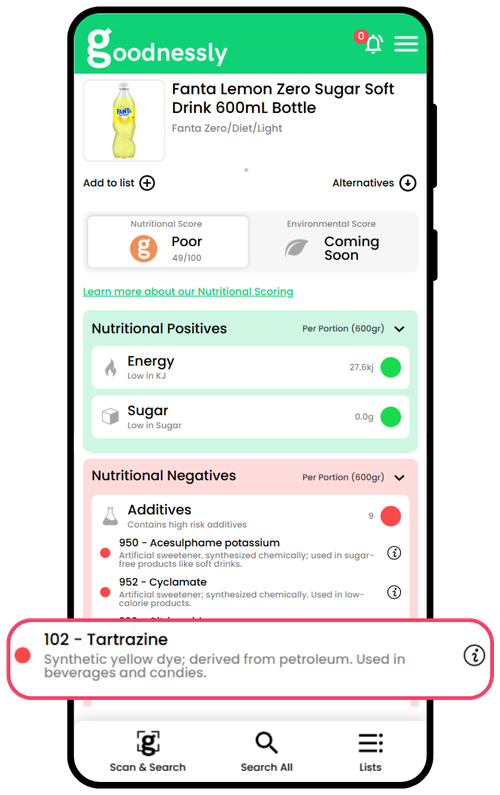
What is yeast extract?
Yeast extract is made from bakers’, brewers’ or other food yeasts. The yeast is broken down by its own or added enzymes, heated and filtered, and the soluble part is concentrated. It is rich in free amino acids, especially glutamic acid, and in nucleotides, which together give a strong savoury taste. Because its glutamate is naturally part of the ingredient, it isn’t listed as MSG (621).
What's it used for?
- Savoury, umami flavour
- A flavour base in stocks, soups and gravies
- Seasoning on chips and crackers
- Replacing added MSG in “no added MSG” recipes
Where you'll find yeast extract on the shelf
Look for it in savoury foods, including many marketed as having no added MSG.
Is yeast extract safe? What the research says
Glutamate is naturally present in many foods, such as tomatoes, cheese and mushrooms, and the body handles it the same way whatever its source. JECFA gave glutamates an ADI “not specified” in 1988, while EFSA set a group ADI of 30 mg/kg body weight per day for glutamate additives in 2017 and noted that some people’s intake may exceed it. Some studies associate large doses of glutamate with symptoms such as headache, but regulators haven’t found a consistent effect at normal intakes from food. Yeast extract is also often high in sodium.
| Region | Status | What this means |
|---|---|---|
| AU/NZ Australia & New Zealand (FSANZ) | Permitted (food ingredient) | Sold as a food ingredient, not a numbered additive, and listed by name. Allergens such as gluten must be declared if present (Standard 1.2.3). |
| EU European Union (EFSA) | Permitted (food ingredient) | Sold as a food ingredient rather than an authorised additive, so it has no E-number. |
| US United States (FDA) | GRAS | Bakers’ yeast extract is GRAS (21 CFR 184.1983). FDA considers “No MSG” claims misleading on foods containing sources of free glutamate. |
Yeast extract is different from yeast mannoproteins (455), a wine stabiliser.
- EFSA, 2017: Set a group ADI of 30 mg/kg body weight per day for glutamic acid and glutamate additives (E620–E625). It applies to added glutamates, but it’s useful context for glutamate-rich ingredients like yeast extract.
This section is checked periodically rather than continuously — if you're reading this well after the date above, it's worth confirming nothing has changed before citing it.
Who might want to limit or avoid it
- People sensitive to glutamate or avoiding MSG
- People watching their sodium intake
- People with coeliac disease, as some yeast extracts are made from brewers’ yeast (check the allergen statement)
Goodnessly rates yeast extract Hazardous Risk. It is permitted as a food ingredient everywhere, but it is a concentrated source of free glutamate and sodium that doesn’t appear as MSG on the label, in line with how we rate MSG (621).
How to spot it on a label
Look out for:
- Yeast extract
- Autolysed yeast or autolysed yeast extract
- Hydrolysed yeast
- Yeast extract powder
Always check the ingredient list, as the same ingredient can be listed under different names.
Related additives
Frequently asked questions
Is yeast extract the same as MSG?
No. MSG (621) is a purified glutamate additive, while yeast extract is a food ingredient that naturally contains free glutamate along with other amino acids and nucleotides. Both add a savoury taste.
Can a product with yeast extract say ‘no added MSG’?
In the US, the FDA considers ‘No MSG’ claims misleading on foods that contain sources of free glutamate such as autolysed yeast. In Australia and New Zealand, claims must not be misleading, so it’s worth checking the ingredient list yourself.
Is yeast extract gluten free?
Not always. Some yeast extracts are made from brewers’ yeast and may contain gluten. In Australia and New Zealand gluten must be declared, so check the allergen statement.
How does Goodnessly rate yeast extract?
Goodnessly rates yeast extract as Hazardous Risk. It is permitted as a food ingredient, but it is a concentrated source of free glutamate and sodium that isn’t listed as MSG on the label.
Don't decode labels by hand
Scan any product with the Goodnessly app to instantly see its full additive breakdown, kept current as new research like this comes to light.
Download our app to check additives in everyday foods