
Additive 431: what is polyoxyethylene (40) stearate?
Also labelled: Polyoxyethylene (40) stearate · PEG-40 stearate · Polyoxyethylene 40 monostearate · Emulsifier 431 · INS 431
A synthetic emulsifier made from stearic acid and polyethylene glycol.
Polyoxyethylene (40) stearate (431) is a synthetic emulsifier made by reacting stearic acid with ethylene oxide. It is permitted in Australia and New Zealand. The EU has no authorised food uses for it, and the US has no direct food additive listing. Goodnessly rates it Hazardous Risk.
Permitted in Australia and New Zealand (FSANZ) but not approved for food use in the EU or the US. The EU lists E431 by name but authorises no food uses for it in Annex II Part E. We found no US direct food additive listing.
Download our app to check additives in everyday foods
Read the FAQ →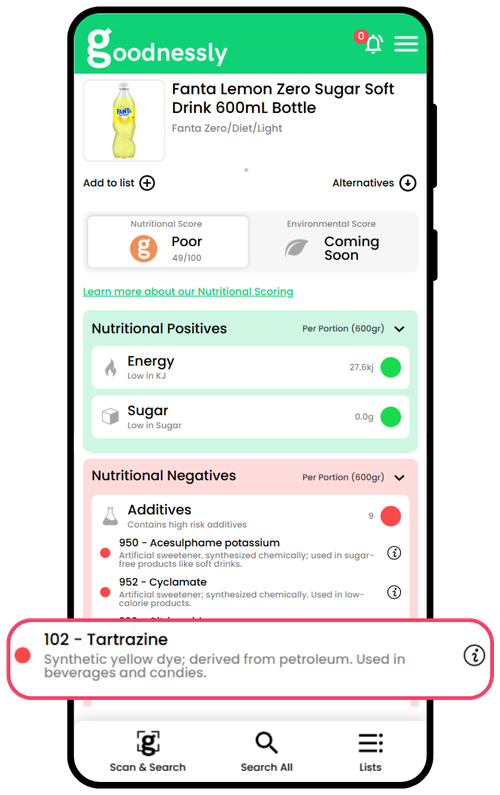
What is polyoxyethylene (40) stearate?
It is a polyoxyethylene ester of stearic acid, often called PEG-40 stearate. Its job is to help oil and water mix.
What's it used for?
- Emulsifier in dried milk, milk powder and cream powder
- Processing aid in wine, sparkling wine and fortified wine
Where you'll find polyoxyethylene (40) stearate on the shelf
It is uncommon in foods.
Is polyoxyethylene (40) stearate safe? What the research says
JECFA has evaluated polyoxyethylene stearates in the past. Neither the EU nor the US currently authorises it for direct food use.
| Region | Status | What this means |
|---|---|---|
| AU/NZ Australia & New Zealand (FSANZ) | Permitted | Permitted at GMP in dried milk, milk and cream powders and in wine under Schedule 15. |
| EU European Union (EFSA) | No authorised uses | Named in Annex II Part B, but there is no food-category authorisation in Part E (consolidated text dated 18 August 2026). |
| US United States (FDA) | Not permitted | We found no 21 CFR direct food additive listing. |
Its EU status was taken from the consolidated Regulation (EC) No 1333/2008.
- EU check, Oct 2026: No E431 food uses are listed in Annex II Part E.
This section is checked periodically rather than continuously — if you're reading this well after the date above, it's worth confirming nothing has changed before citing it.
Who might want to limit or avoid it
- Anyone who prefers additives approved in the EU and US
- People limiting synthetic emulsifiers
Goodnessly rates 431 Hazardous Risk. It has no authorised food uses in the EU and no direct US approval.
How to spot it on a label
Look out for:
- Polyoxyethylene (40) stearate
- Emulsifier (431)
- PEG-40 stearate
Always check the ingredient list, as the same ingredient can be listed under different names.
Related additives
Frequently asked questions
What is PEG-40 stearate?
It is another name for polyoxyethylene (40) stearate, a synthetic emulsifier.
Is 431 allowed in the EU or US?
The EU authorises no food uses for it, and the US has no direct food additive listing. It is permitted in Australia and New Zealand.
Is polyoxyethylene (40) stearate a polysorbate?
No, but they are related synthetic emulsifiers. Polysorbates (432 to 436) are made with sorbitan.
How does Goodnessly rate 431?
Goodnessly rates 431 (Polyoxyethylene (40) stearate) as Hazardous Risk. It has no authorised food uses in the EU and no direct US approval.
Don't decode labels by hand
Scan any product with the Goodnessly app to instantly see its full additive breakdown, kept current as new research like this comes to light.
Download our app to check additives in everyday foods