
What is 952?
An intense artificial sweetener, about 30 to 50 times sweeter than sugar.
Cyclamate (952), which includes cyclamic acid and its sodium and calcium salts, is an artificial sweetener. It is permitted in Australia and New Zealand and authorised in the EU, but it has been banned in US food since 1969. Goodnessly rates it Moderate Risk.
Permitted in Australia and New Zealand (FSANZ) and in the EU, but not approved in the US. The FDA banned cyclamate in 1969, and it remains listed as a prohibited substance (21 CFR 189.135).
Download our app to check additives in everyday foods
Read the FAQ →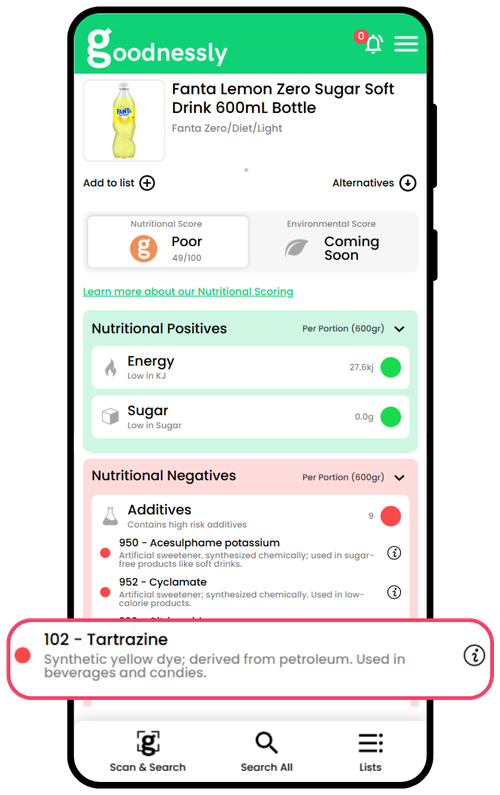
What is cyclamate?
Cyclamate is often blended with saccharin to improve taste. Some people convert part of it to cyclohexylamine in the gut.
What's it used for?
- Tabletop sweeteners
- Low-joule soft drinks and juices
- Jams and jelly
- Low-joule chewing gum
Where you'll find 952 on the shelf
Look for it in diet drinks and tabletop sweeteners.
Is cyclamate safe? What the research says
The US ban followed 1960s studies of a cyclamate-saccharin mix that indicated bladder tumours in rats. Later evaluations did not confirm cancer concerns. JECFA has an ADI of 0 to 11 mg/kg body weight, and the EU SCF set 7 mg/kg body weight in 2000, based on effects of cyclohexylamine on the testes in rats.
| Region | Status | What this means |
|---|---|---|
| AU/NZ Australia & New Zealand (FSANZ) | Permitted | Permitted under Schedule 15 in specified foods such as tabletop sweeteners, low-joule drinks, jams and jelly. |
| EU European Union (EFSA) | Permitted | Authorised as E952, mainly in energy-reduced or no-added-sugar products. |
| US United States (FDA) | Banned | Prohibited from food under 21 CFR 189.135, following the 1969 order. |
A petition to re-approve it in the US has never been granted.
- US: Cyclamate remains on the FDA list of substances prohibited from use in food (checked October 2026).
This section is checked periodically rather than continuously — if you're reading this well after the date above, it's worth confirming nothing has changed before citing it.
Who might want to limit or avoid it
- Children and high consumers of diet drinks, who may approach the ADI
- Anyone limiting artificial sweeteners
Goodnessly rates 952 Moderate Risk. It has been banned in US food since 1969, although it is permitted in the EU and Australia.
How to spot it on a label
Look out for:
- Cyclamate or sodium cyclamate
- Sweetener (952)
Always check the ingredient list, as the same additive can be listed by name or by number.
Related additives
Frequently asked questions
Why is cyclamate banned in the US?
A 1969 FDA order banned it after studies of a cyclamate-saccharin mix indicated bladder tumours in rats. Later reviews did not confirm a cancer risk.
Is 952 allowed in the EU?
Yes, it is authorised as E952. It is permitted in Australia and New Zealand but banned in the US.
What is the ADI for cyclamate?
JECFA sets 0 to 11 mg/kg body weight. The EU uses 7 mg/kg body weight.
How does Goodnessly rate 952?
Goodnessly rates 952 (Cyclamate) as Moderate Risk. It has been banned in US food since 1969, although it is permitted in the EU and Australia.
Don't decode labels by hand
Scan any product with the Goodnessly app to instantly see its full additive breakdown, kept current as new research like this comes to light.
Download our app to check additives in everyday foods