
Additive 956: what is alitame?
Also labelled: Alitame · Sweetener 956 · INS 956
An intense sweetener made from amino acids, listed in Australia and New Zealand but not approved in the EU or US.
Alitame (956) is a synthetic intense sweetener built from the amino acids L-aspartic acid and D-alanine. It is listed in the Australia New Zealand Food Standards Code, but it is not approved in the EU or US. Goodnessly rates it Moderate Risk.
Alitame is not approved in the EU or US. It is listed in the Australia New Zealand Food Standards Code (Schedule 8, code 956). It is not on the EU Union list of food additives, and the only US food additive petition for it was withdrawn in 2008 without an FDA approval.
Download our app to check additives in everyday foods
Read the FAQ →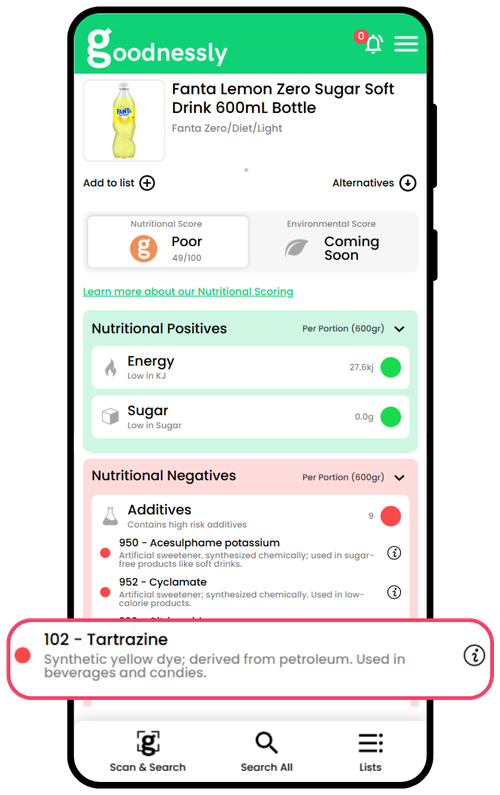
What is alitame?
JECFA describes alitame as L-α-aspartyl-N-(2,2,4,4-tetramethyl-3-thietanyl)-D-alaninamide, made by a multistep synthesis and sold as a hydrated crystalline powder. Its functional class is sweetening agent. Like other intense sweeteners, only tiny amounts are needed.
What's it used for?
- Intense sweetener (JECFA functional class: sweetening agent)
- Proposed in the US as a sweetening agent or flavouring, though that petition was withdrawn
Where you'll find 956 on the shelf
Alitame is rarely seen on Australian ingredient lists. If it is used, it will be listed by name or as 956.
Is alitame safe? What the research says
JECFA allocated alitame an ADI of 0–1 mg/kg body weight in 1996 and maintained it in 2002. At an earlier evaluation (1995) JECFA did not allocate an ADI. Neither the EU nor the US has approved it, so it has no EFSA or FDA safety assessment as an authorised additive.
| Region | Status | What this means |
|---|---|---|
| AU/NZ Australia & New Zealand (FSANZ) | Permitted | Listed in the Food Standards Code as alitame, code number 956 (Schedule 8). |
| EU European Union (EFSA) | Not approved | Not on the Union list of authorised food additives under Regulation (EC) No 1333/2008. |
| US United States (FDA) | Not approved | No FDA approval. The food additive petition (FAP 6A3958) to allow alitame as a sweetening agent or flavouring was withdrawn in June 2008 (73 FR 35143). |
JECFA ADI: 0–1 mg/kg body weight (set 1996, maintained 2002).
- US, June 2008: The FDA announced the withdrawal, without prejudice to a future filing, of the only food additive petition for alitame.
- JECFA, 2002: JECFA kept its ADI of 0–1 mg/kg body weight at its 59th meeting.
This section is checked periodically rather than continuously — if you're reading this well after the date above, it's worth confirming nothing has changed before citing it.
Who might want to limit or avoid it
- Anyone who prefers additives approved in the EU and US
- People limiting intense sweeteners
- Parents keeping an eye on sweeteners in children's food
Goodnessly rates 956 Moderate Risk. It is not approved in the EU or US, although JECFA has set an ADI and it is listed in Australia and New Zealand.
How to spot it on a label
Look out for:
- Alitame
- Sweetener (956)
- 956
Always check the ingredient list, as the same additive can be listed by name or by number.
Related additives
Frequently asked questions
Is alitame approved in the EU or US?
No. Alitame is not approved in the EU or US. It is not on the EU Union list of food additives, and the only US petition for it was withdrawn in 2008.
Is alitame allowed in Australia?
Yes. Alitame is listed in the Australia New Zealand Food Standards Code with the code number 956.
Has alitame been safety assessed?
JECFA, the joint FAO/WHO expert committee, set an acceptable daily intake of 0 to 1 mg per kg of body weight in 1996 and kept it in 2002.
How does Goodnessly rate 956?
Goodnessly rates 956 (Alitame) as Moderate Risk. It is not approved in the EU or US, although JECFA has set an ADI and it is listed in Australia and New Zealand.
Don't decode labels by hand
Scan any product with the Goodnessly app to instantly see its full additive breakdown, kept current as new research like this comes to light.
Download our app to check additives in everyday foods