
Additive 962 (E962): what is aspartame-acesulphame salt?
Also labelled: Aspartame-acesulphame salt · Salt of aspartame-acesulfame · Sweetener 962 · INS 962 · E962
An intense sweetener made by combining aspartame and acesulphame potassium into a single salt.
Aspartame-acesulphame salt (962) is an intense sweetener formed from aspartame and acesulphame, about 350 times sweeter than sugar. It is permitted in Australia and New Zealand and authorised in the EU as E962, but the US has no specific FDA listing for the combined salt (aspartame and acesulfame potassium are each listed separately). Goodnessly rates it Hazardous Risk.
Permitted in Australia and New Zealand (FSANZ) and authorised in the EU, but the salt itself is not specifically approved in the US. The FDA lists aspartame (21 CFR 172.804) and acesulfame potassium (21 CFR 172.800) separately, but we found no US listing for the combined salt.
Download our app to check additives in everyday foods
Read the FAQ →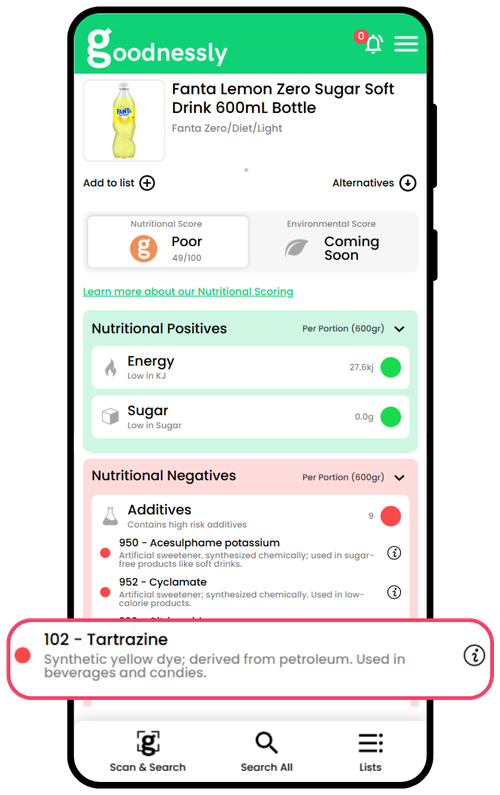
What is aspartame-acesulphame salt?
It is made by combining aspartame and acesulphame in a fixed ratio to form a single salt. When it dissolves, it separates back into aspartame and acesulphame. Because it contains aspartame, it is a source of phenylalanine.
What's it used for?
- Sweetening energy-reduced and no-added-sugar drinks
- Sugar-free desserts and dairy-style products
- Chewing gum and sugar-free confectionery
- Table-top sweeteners
Where you'll find aspartame-acesulphame salt on the shelf
Look for it in “diet”, “lite” or “no added sugar” products.
Is aspartame-acesulphame salt safe? What the research says
Each part of this salt has been assessed on its own. EFSA set an ADI of 40 mg/kg body weight for aspartame in 2013, and JECFA reaffirmed its 40 mg/kg ADI in 2023. In 2023 IARC classified aspartame as “possibly carcinogenic to humans” (Group 2B), a hazard category based on limited evidence. Regulators said this did not change their safe intake levels.
| Region | Status | What this means |
|---|---|---|
| AU/NZ Australia & New Zealand (FSANZ) | Permitted | Permitted as a sweetener in a range of foods under Schedule 15. Products with aspartame or aspartame-acesulphame salt must carry a phenylalanine warning for people with phenylketonuria. |
| EU European Union (EFSA) | Permitted | Authorised as E962 “salt of aspartame-acesulfame”, limited to energy-reduced products or products with no added sugar. |
| US United States (FDA) | No specific listing | No 21 CFR listing for the combined salt. Aspartame (172.804) and acesulfame potassium (172.800) are each listed separately. |
Its intake is assessed against the separate ADIs for aspartame and acesulphame.
- IARC and JECFA, July 2023: IARC classified aspartame as Group 2B (possibly carcinogenic), while JECFA kept the ADI at 40 mg/kg body weight.
- US status: The FDA has not listed the combined salt in 21 CFR. We checked eCFR in October 2026.
This section is checked periodically rather than continuously — if you're reading this well after the date above, it's worth confirming nothing has changed before citing it.
Who might want to limit or avoid it
- People with phenylketonuria (PKU), who must avoid phenylalanine
- Anyone choosing to limit artificial sweeteners
- Parents keeping an eye on how many intensely sweetened products their children have
Goodnessly rates 962 Hazardous Risk. It contains aspartame, which IARC classified as possibly carcinogenic in 2023, and the combined salt has no specific US approval.
How to spot it on a label
Look out for:
- Aspartame-acesulphame salt
- Sweetener (962)
- E962
- A “contains phenylalanine” warning
Always check the ingredient list, as the same ingredient can be listed under different names.
Related additives
Frequently asked questions
Is aspartame-acesulphame salt the same as aspartame?
No. It is a salt of aspartame and acesulphame combined. Once dissolved, it separates into the two sweeteners, so it still provides phenylalanine.
Is 962 allowed in the US?
The FDA lists aspartame and acesulfame potassium separately, but we found no 21 CFR listing for the combined salt. It is permitted in Australia, New Zealand and the EU.
Why do products with 962 carry a phenylalanine warning?
Aspartame is a source of phenylalanine. People with phenylketonuria cannot break it down properly, so the Food Standards Code requires a warning statement.
How does Goodnessly rate 962?
Goodnessly rates 962 (Aspartame-acesulphame salt) as Hazardous Risk. It contains aspartame, which IARC classified as possibly carcinogenic in 2023, and the combined salt has no specific US approval.
Don't decode labels by hand
Scan any product with the Goodnessly app to instantly see its full additive breakdown, kept current as new research like this comes to light.
Download our app to check additives in everyday foods