
What is 127?
A synthetic cherry-pink food colour, known in the US as FD&C Red No. 3.
Erythrosine (127) is a synthetic, iodine-containing pink-red colour, called FD&C Red No. 3 in the US. It is permitted in Australia and New Zealand. The EU restricts it to cocktail, candied and Bigarreaux cherries, and the US FDA has revoked its use in food from 15 January 2027. Goodnessly rates it Hazardous Risk.
Permitted in Australia and New Zealand (FSANZ) but restricted in the EU and being removed in the US. The EU allows erythrosine only in cocktail, candied and Bigarreaux cherries. The FDA revoked its authorisation for food in January 2025, with manufacturers given until 15 January 2027 to reformulate.
Download our app to check additives in everyday foods
Read the FAQ →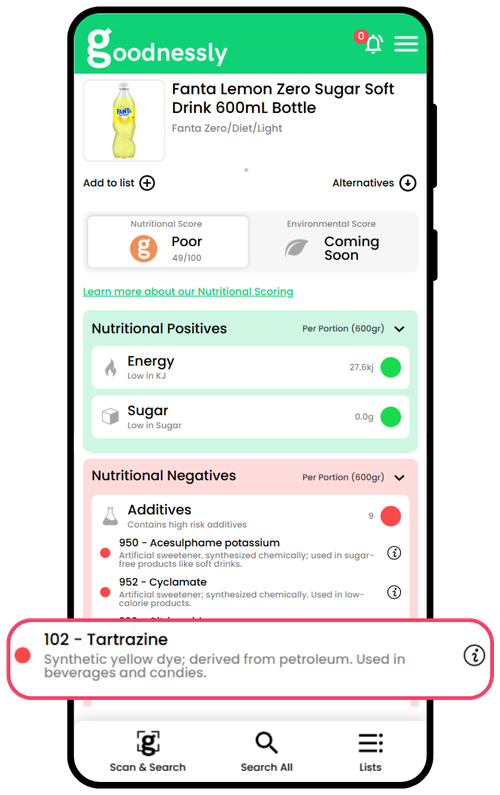
What is erythrosine?
Erythrosine is a xanthene dye that contains iodine. It gives a bright cherry-pink colour and is best known from glacé and cocktail cherries.
What's it used for?
- Colouring glacé and cocktail cherries
- Icings and frostings (at very low levels)
Where you'll find 127 on the shelf
In Australia it is most often found in preserved cherries.
Is erythrosine safe? What the research says
EFSA re-evaluated erythrosine in 2011 and kept the ADI of 0.1 mg/kg body weight. It noted that the thyroid tumours seen in rats are linked to effects on thyroid function and may be of limited relevance to humans. The FDA revoked the US food listing under the Delaney Clause, because high doses were associated with cancer in male rats. The FDA also stated that the mechanism does not occur in humans.
| Region | Status | What this means |
|---|---|---|
| AU/NZ Australia & New Zealand (FSANZ) | Permitted | Permitted under Schedule 15 in preserved cherries (maraschino, cocktail or glacé, up to 200 mg/kg) and icings and frostings (up to 2 mg/kg). |
| EU European Union (EFSA) | Restricted | Authorised as E127 only in cocktail cherries, candied cherries and Bigarreaux cherries. It may not be sold directly to consumers. |
| US United States (FDA) | Revoked | FDA revoked FD&C Red No. 3 for food in January 2025. The revocation takes effect on 15 January 2027. |
The ADI of 0.1 mg/kg body weight is set by both JECFA and EFSA.
- FDA, 15 Jan 2025: The FDA revoked authorisation for Red No. 3 in food and ingested drugs. Food has a deadline of 15 January 2027 and drugs 18 January 2028.
- FDA, 2025: The FDA encouraged manufacturers to phase it out before the 2027 deadline.
This section is checked periodically rather than continuously — if you're reading this well after the date above, it's worth confirming nothing has changed before citing it.
We have also written a longer article about the US decision and what it means in Australia: The US Just Banned Red 3 Food Dye.
Who might want to limit or avoid it
- People with thyroid conditions or iodine sensitivity, as erythrosine contains iodine (talk to your doctor)
- Parents limiting synthetic colours
- Shoppers comparing imported products
Goodnessly rates 127 Hazardous Risk. It is heavily restricted in the EU and is being removed from US food. The US decision was legal, based on rat studies.
How to spot it on a label
Look out for:
- Erythrosine
- Colour (127)
- FD&C Red No. 3 or Red 3 on US imports
Always check the ingredient list, as the same additive can be listed by name or by number.
Related additives
Frequently asked questions
Is erythrosine the same as Red No. 3?
Yes. Erythrosine is called FD&C Red No. 3 in the US.
Is erythrosine banned in the US?
The FDA revoked its food authorisation in January 2025. Manufacturers have until 15 January 2027 to remove it. In the EU it is only allowed in certain cherries.
Why did the FDA revoke Red No. 3?
The Delaney Clause bars colours shown to cause cancer in animals. High doses were associated with cancer in male rats. The FDA said the rat mechanism does not occur in humans.
How does Goodnessly rate 127?
Goodnessly rates 127 (Erythrosine) as Hazardous Risk. It is heavily restricted in the EU and is being removed from US food. The US decision was legal, based on rat studies.
Don't decode labels by hand
Scan any product with the Goodnessly app to instantly see its full additive breakdown, kept current as new research like this comes to light.
Download our app to check additives in everyday foods